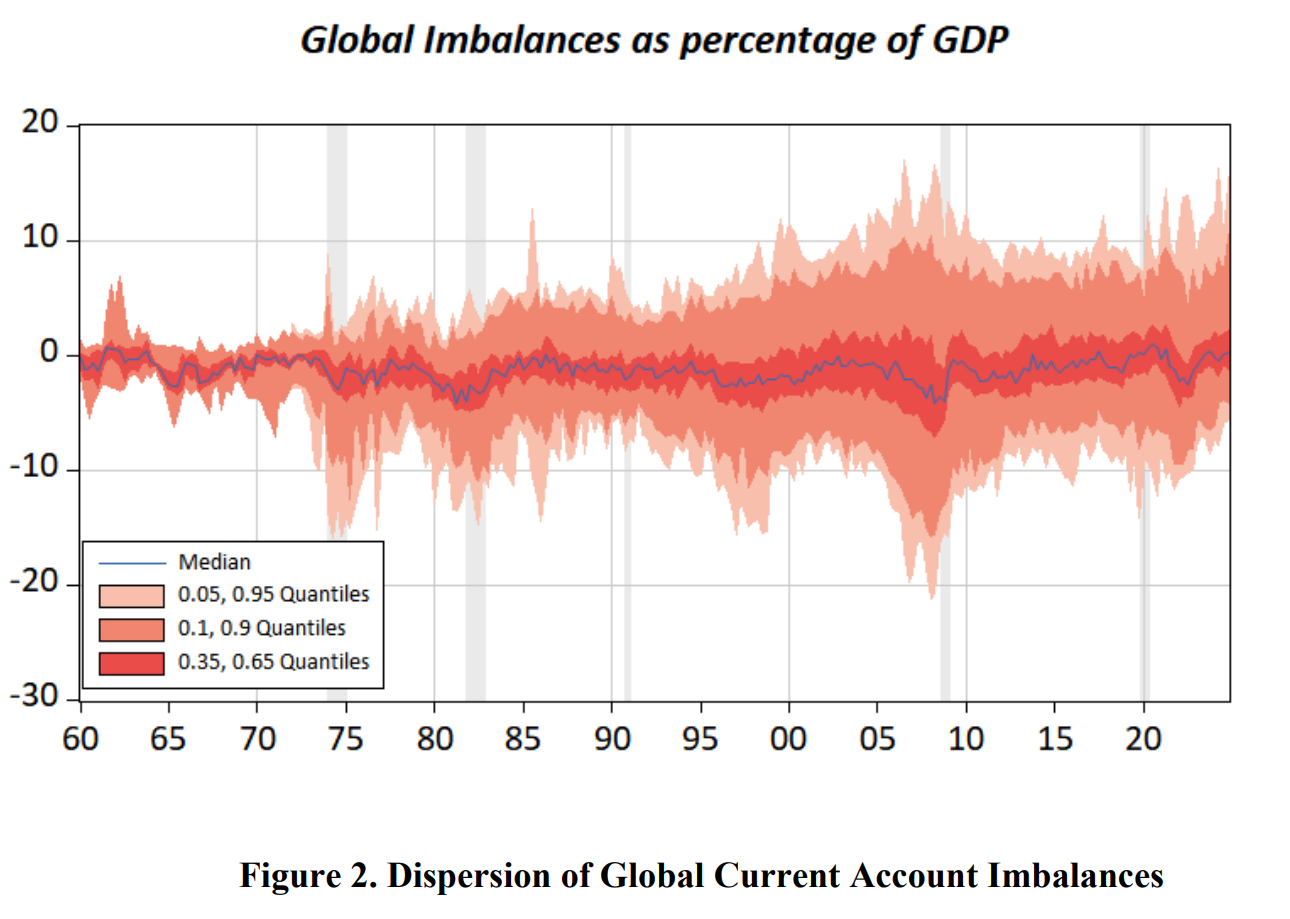
NEW WORKING PAPER: This paper examines the structural determinants of current account balance (CAB) dynamics for a panel of 74 countries spanning 1971-2023. We characterize external adjustment behavior through a two-stage empirical strategy. In the first stage, we estimate country-specific Markov switching autoregressive models that classify each country-year observation into one of three dynamic regimes-explosive, unit root, or stationary-allowing persistence, mean, and volatility to switch independently. In the second stage, we estimate a multinomial logit model to identify the structural factors that predict regime membership. Fixed exchange rate arrangements reduce the probability of explosive current account dynamics by approximately nine percentage points on average, while manufacturing export specialization and trade openness increase it. These effects operate primarily through the explosive-versus-nonexplosive channel. Within the stable regime space, the same structural variables do not reliably distinguish stationary from unit root behavior. Model fit is substantially higher for emerging market economies, indicating that exchange rate and trade policy are most consequential for middle-income countries. These findings contribute to the understanding of how macroeconomic policy frameworks shape the dynamics of external adjustment.
You are welcome to download, share, or comment on the following working paper:
- Clower, E., Ito, H., & Saadaoui, J. (2026). What Drives Persistence in Current Account Imbalances? (April 17, 2026). Available at SSRN: 6595060.