The joint rise in Chinese and Russian gold reserves since the 2000s is more than a portfolio story. It also reflects a geopolitical realignment that became increasingly visible around 2014, when Russia’s annexation of Crimea and the outbreak of war in eastern Ukraine marked the beginning of the broader Russia-Ukraine war. Major reference timelines date the start of that war to February 2014, not 2022.
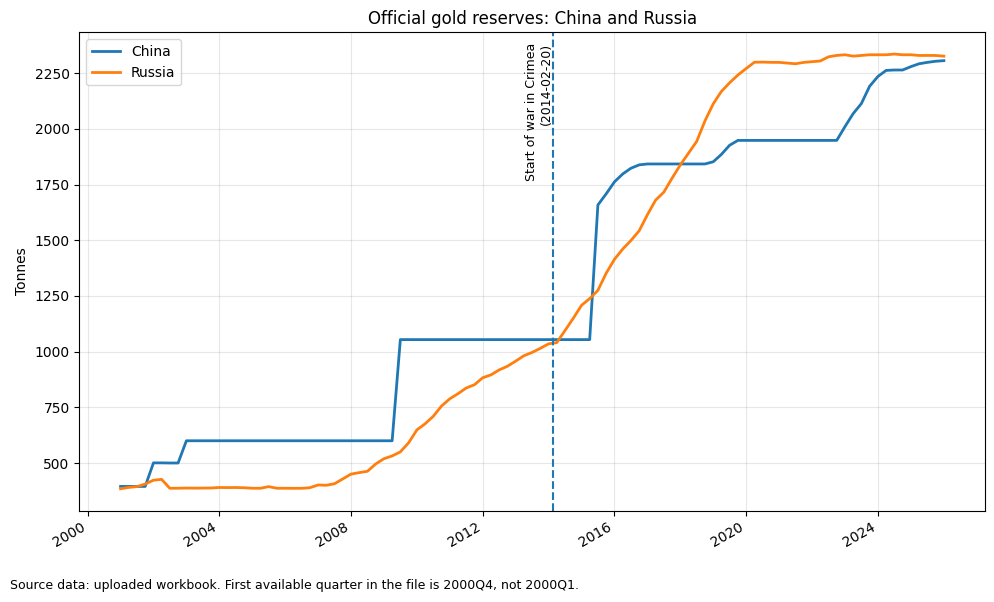
Against that backdrop, the steady accumulation of official gold by both Moscow and Beijing can be read as part of a wider effort to reduce exposure to a Western-centered financial order. Gold is not only a reserve asset; it is also a strategic hedge against sanctions risk, currency dependence, and geopolitical fragmentation. This does not prove a formal alliance, but it is consistent with a progressively stronger alignment between Russia and China that was already observable during the Crimea episode, which can reasonably be described as the first war in Ukraine. The official quarterly gold-reserve series tracked by the World Gold Council provides the empirical backdrop for this interpretation.
This alignment was also visible symbolically in February 2014. Xi Jinping attended the opening ceremony of the Sochi Winter Olympics, marking the first time that a Chinese head of state had attended a major international sporting event abroad. Chinese official communication presented that visit as a sign of the importance of the China-Russia relationship. The timing is striking: this diplomatic gesture took place just before the Crimea episode, which makes it an early and highly visible signal of the closer political understanding between Beijing and Moscow.
Taken together, the accumulation of gold reserves and the diplomatic symbolism of Sochi suggest that the rapprochement between Russia and China was already observable at the start of the first war in Ukraine. The reserve data do not prove a formal alliance, but they fit well with the broader pattern of strategic alignment that has become more evident over time.