NEW PUBLICATION: We implement a two-step analysis of fiscal and external causality patterns using a data set for 27 EU countries in the period 2002Q1-2023Q4. In the first step, we compute fiscal and external sustainability time-varying coefficients, modelling the relationship between government revenues and government spending, and between exports and imports. In the second step, we use three recursive strategies, combined with Granger causality tests: forward expanding, rolling, and recursive window methods to capture causal relationships. Our results show that: (i) peripheral countries have lower sustainability coefficients, while non-Eurozone countries have higher sustainability coefficients, (ii) after the 2008 global financial crisis, there was an improvement in fiscal and external sustainability for most countries, (iii) during the Eurozone crisis in 2010-2012, in Austria, France, Greece, Ireland, Netherlands, Slovakia and Spain, improving fiscal sustainability lead to a better external sustainability, (iv) during that period, improvement of external sustainability lead to a better fiscal sustainability in EMU countries (Austria, Germany, Malta, Netherlands, Slovakia, Slovenia, Spain) and in non-EMU countries.
You can find the preprint version, the abstract, the keywords, and the online appendix in the following link:
https://papers.ssrn.com/sol3/papers.cfm?abstract_id=5137618
You can quote this article as:
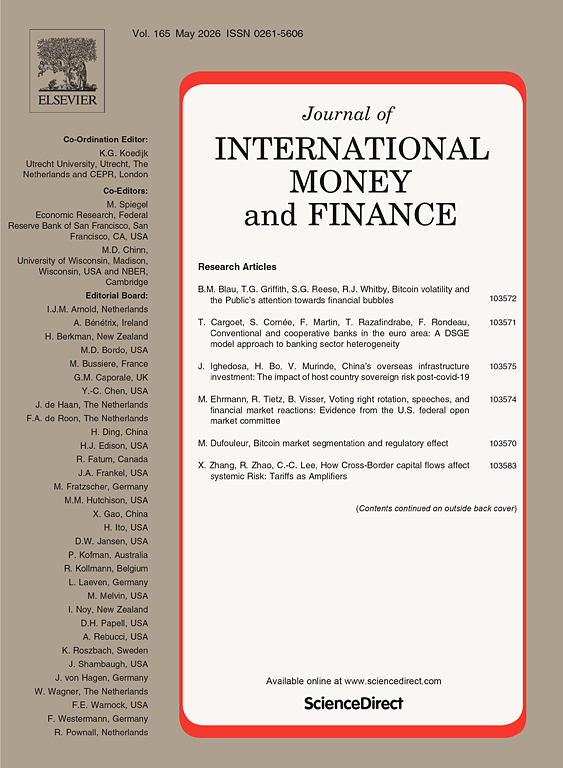
Afonso, A., Alves, J., Coelho, J. C. & Saadaoui, J. (2026). What are the causal links between fiscal and external sustainability in the EU? New time-varying evidence, Journal of International Money and Finance, 167, 103610.
1 Comment
[…] paper “What are the causal links between fiscal and external sustainability in the EU? New time-varying evi…” studies 27 EU countries over 2002Q1–2023Q4. The empirical strategy proceeds in two steps. […]