A geopolitical shock can prompt central banks to lower interest rates initially and raise them a year later. The timing of the response reveals how monetary authorities balance the immediate deterioration in confidence against subsequent inflationary pressures.
Our paper, Monetary policy reaction to geopolitical risks in unstable environments, written with William Ginn and published in Macroeconomic Dynamics, examines this adjustment using a panel of 18 economies and both constant-parameter and time-varying local projections.
The central result is a change in the direction of the monetary response across horizons. Initial accommodation gives way to tightening in the medium run. In the full-sample panel, the short-term interest rate rises by approximately 0.5 percentage points after twelve months following the paper’s unit geopolitical risk shock. The time-varying estimates show how the strength of this response differs across historical episodes.
Read the published article · Read the paper (PDF)
Geopolitical risk in the monetary-policy reaction function
The monthly sample runs from February 2000 to February 2022. It combines short-term interest rates, inflation, an output-gap measure based on industrial production, recession indicators, and country-specific geopolitical risk indices from Caldara and Iacoviello. For the euro area, the paper constructs a GDP-weighted geopolitical risk index from eight member countries.
The starting point is a Taylor rule augmented with geopolitical risk. The paper’s baseline equation can be written as:
Here, \(R\) is the short-term interest rate, \(GAP\) the output gap, \(INF\) year-on-year inflation, \(GPR\) geopolitical risk, and \(REC\) the recession indicator. Country fixed effects \(\alpha_i\) absorb persistent differences across economies. The twelve-month lags on the interest rate and GPR capture monetary inertia and the medium-run association between geopolitical tensions and policy.
The estimates show the expected positive responses to inflation and the output gap. The lagged GPR coefficient is positive and statistically significant in the full panel and the developed-economy group. The dynamic analysis then traces the adjustment month by month.
From initial accommodation to medium-run tightening
The panel local projections include country fixed effects and use a lag-augmented specification with two lags. Figure 1 reproduces the full-sample response from the paper. The confidence bands are constructed using 200 bootstrap replications with clustering at the country level.
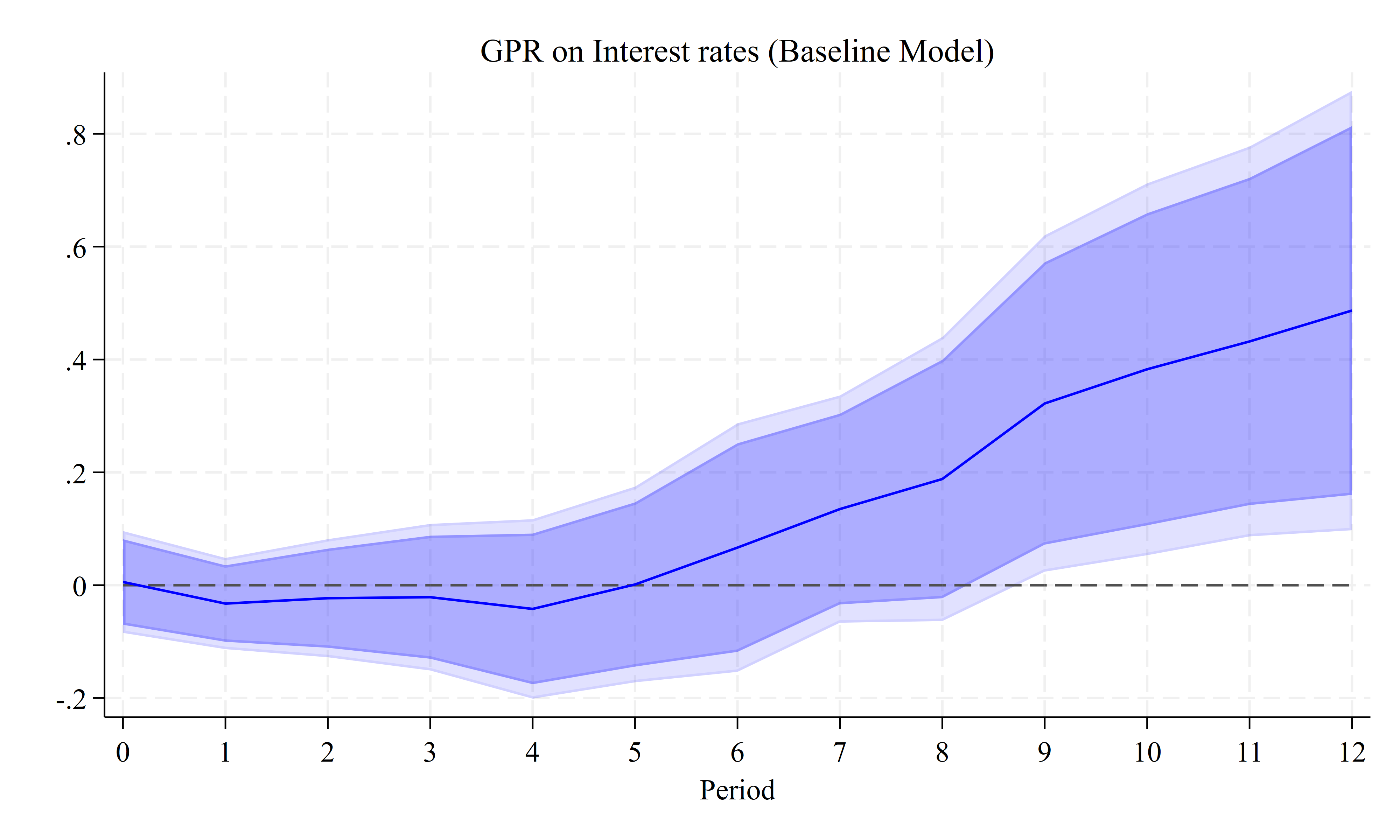
The response becomes increasingly positive over the projection horizon, reaching approximately 0.5 percentage points at month twelve. The developed-economy estimates display a similar pattern. Emerging economies also show a positive medium-run response, with greater heterogeneity across individual countries.
The country-level constant-parameter estimates sharpen this comparison. For the United Kingdom, Canada, and Israel, the medium-run increase is approximately one percentage point. These cases motivate a closer examination of how the policy response changes over calendar time.
The same horizon, different historical responses
The time-varying local projections use the parameter-path estimator of Inoue, Rossi, and Wang (2024). For each horizon, the method estimates a coefficient path over the sample. The specification is:
The variable \(S_t\) denotes the GPR shock. The coefficient \(\beta_{h,t+h}\) measures the interest-rate response at horizon \(h\) associated with shock date \(t\). The controls include two lags of the interest rate, inflation, the output gap, and the GPR shock. This formulation allows the response at a given horizon to evolve across historical episodes.
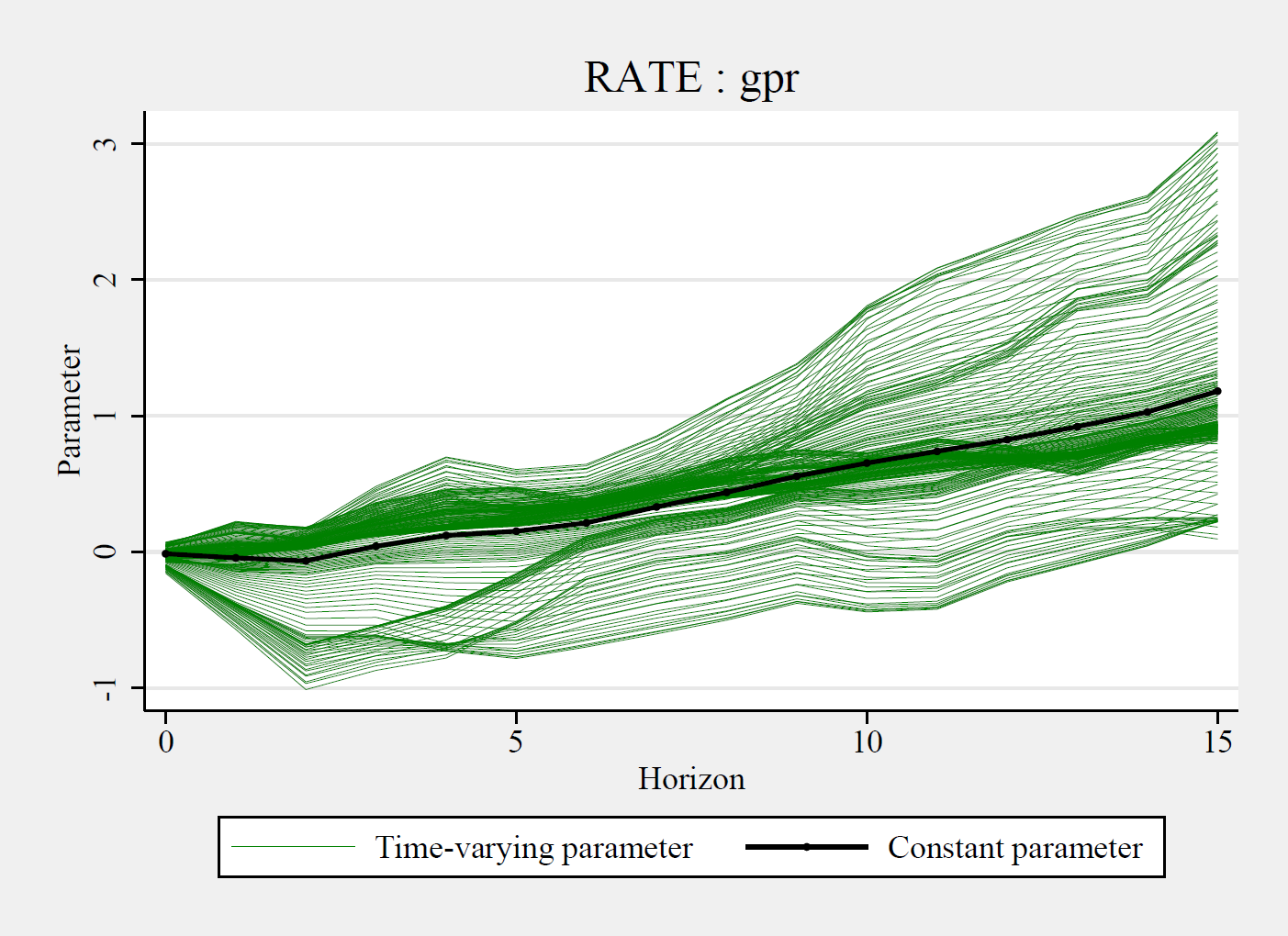
The United Kingdom illustrates the economic importance of this variation. Some dated responses approach −1 percentage point after three months, while medium-run responses reach approximately +3 percentage points after fifteen months. The collection of green curves shows the dispersion of estimated responses across dates.
The historical profiles provide further detail. For the United Kingdom and Canada, the paper identifies especially strong short-run accommodation around the September 2001 attacks. Medium-run tightening is particularly pronounced before the global financial crisis, when oil prices were elevated. The fixed-horizon parameter plots document significant departures from the constant-parameter benchmark during these episodes.
Confidence today, inflationary pressure later
The paper interprets these dynamics through the different channels of geopolitical transmission. A sudden deterioration in confidence can weaken spending and investment, creating an immediate incentive for monetary accommodation. Supply disruptions, higher commodity prices, and interruptions to trade can subsequently increase inflationary pressure. Fiscal and monetary support can also reinforce aggregate demand as the shock propagates.
This interpretation gives the change in sign a coherent economic meaning: the policy response evolves with the balance of demand and supply pressures. The paper’s supplementary evidence reports a negative relationship between changes in U.S. geopolitical risk and consumer sentiment, consistent with the confidence channel.
Selecting dates when GPR exceeds its third quartile reveals stronger initial accommodation in the United Kingdom and Canada. Israel displays a different pattern, with particularly strong medium-run tightening during high-GPR episodes. These results show how the geopolitical environment and country circumstances shape the monetary response.
Two related EconMacro posts
My post If Geopolitical Risks Can Be Inflationary, How Central Banks React? connects the paper’s short-run accommodation and medium-run tightening to the inflationary consequences of geopolitical risk. It places the monetary-policy findings alongside EconMacro’s six-part series on geopolitical shocks, inflation, and international spillovers.
My post What does the tvpreg Stata command do? explains the parameter-path approach underlying time-varying local projections. It describes how the estimator uses full-sample information, constructs candidate paths for different degrees of instability, and combines them, with accompanying Stata and Mata examples.
Read the paper
The contribution is to establish the importance of both the projection horizon and the historical environment for monetary-policy responses to geopolitical risk. The panel estimates reveal medium-run tightening, while the time-varying estimates uncover substantial differences in the initial accommodation and subsequent adjustment.
The paper also reports panel estimates with time fixed effects, a twelve-lag specification for the developed-economy group, and state-dependent panel local projections. These exercises complement the country-level evidence and the historical parameter paths.
Ginn, W., and Saadaoui, J. (2025). Monetary policy reaction to geopolitical risks in unstable environments. Macroeconomic Dynamics, 29, e90. https://doi.org/10.1017/S136510052500015X.
Published article · Full paper (PDF)
Selected references and data
Caldara, D., and Iacoviello, M. (2022). Measuring geopolitical risk. American Economic Review, 112(4), 1194–1225. GPR data and documentation.
Inoue, A., Rossi, B., and Wang, Y. (2024). Local projections in unstable environments. Journal of Econometrics, 244(2), 105726.
Jordà, Ò. (2005). Estimation and inference of impulse responses by local projections. American Economic Review, 95(1), 161–182.
Taylor, J. B. (1993). Discretion versus policy rules in practice. Carnegie-Rochester Conference Series on Public Policy, 39, 195–214.