Geopolitical risk reaches euro-area sovereign debt markets through national exposures and risk perceptions. Germany stands out: a rise in geopolitical risk measured in German newspapers is followed by a substantial increase in sovereign stress across the monetary union.
Our paper, Local and Anglosphere-Based Geopolitical Risk and Sovereign Stress in the Euro Area, written with Francesco Frangiamore, was published in Finance Research Letters in 2026.
The central result is economically substantial. A three-standard-deviation increase in German geopolitical risk raises the euro-area sovereign stress index by about 0.1 units after five months. This is comparable to the observed increase between February and March 2022. The estimated response is stronger when geopolitical risk is measured using German-language newspapers.
Read the published paper (PDF) · Journal article and supplementary material · R replication files
Measuring stress across sovereign debt markets
The analysis uses the ECB’s Sovereign Composite Indicator of Systemic Stress (SovCISS). It combines information on risk premia, volatility, transaction costs, and liquidity conditions. The baseline outcome is the real-GDP-weighted euro-area aggregate, which captures several dimensions of market stress within a common indicator.
The monthly sample runs from September 2000 to April 2025. Global geopolitical risk comes from Caldara and Iacoviello (2022). National risk perceptions are measured using the local-language newspaper indices developed by Alonso-Alvarez, Diakonova, and Pérez (2025). Comparing these measures allows the analysis to distinguish the location of geopolitical exposure and the perspective of the newspapers reporting it.
Tracing the response to geopolitical risk
Local projections estimate the response of sovereign stress over the following twelve months. For each geopolitical risk index, the baseline specification is:
\[ \begin{aligned} y_{t+h}={}&\alpha_h+\beta_h GPR_t +\sum_{j=1}^{12}\gamma_{h,j}y_{t-j} +\sum_{j=1}^{12}\delta_{h,j}GPR_{t-j}\\ &+\sum_{j=1}^{12}\phi_{h,j}IPG_{t-j} +\sum_{j=1}^{12}\psi_{h,j}r_{t-j} +\varepsilon_{t+h}, \qquad h=0,\ldots,12. \end{aligned} \tag{1} \]
Here, \(y_t\) is euro-area SovCISS, \(IPG_t\) is manufacturing industrial-production growth, and \(r_t\) is the short-term interest rate. The specification includes twelve lags of sovereign stress, geopolitical risk, and both macro-financial controls.
Identification uses a recursive short-run restriction: geopolitical risk can affect sovereign stress within the month, while feedback from sovereign stress and other macro-financial conditions to measured geopolitical risk begins with a lag of at least one month. Conditional on the included history, this restriction gives the impulse responses their structural interpretation. The reported responses are scaled to a three-standard-deviation increase in the relevant GPR index.
Germany’s distinctive role
The country comparison reveals a clear pattern. German geopolitical risk generates a sizable and persistent increase in euro-area sovereign stress. Global measures and the national indices for the other countries examined generally produce statistically insignificant responses. France shows a mildly significant increase only after seven months.
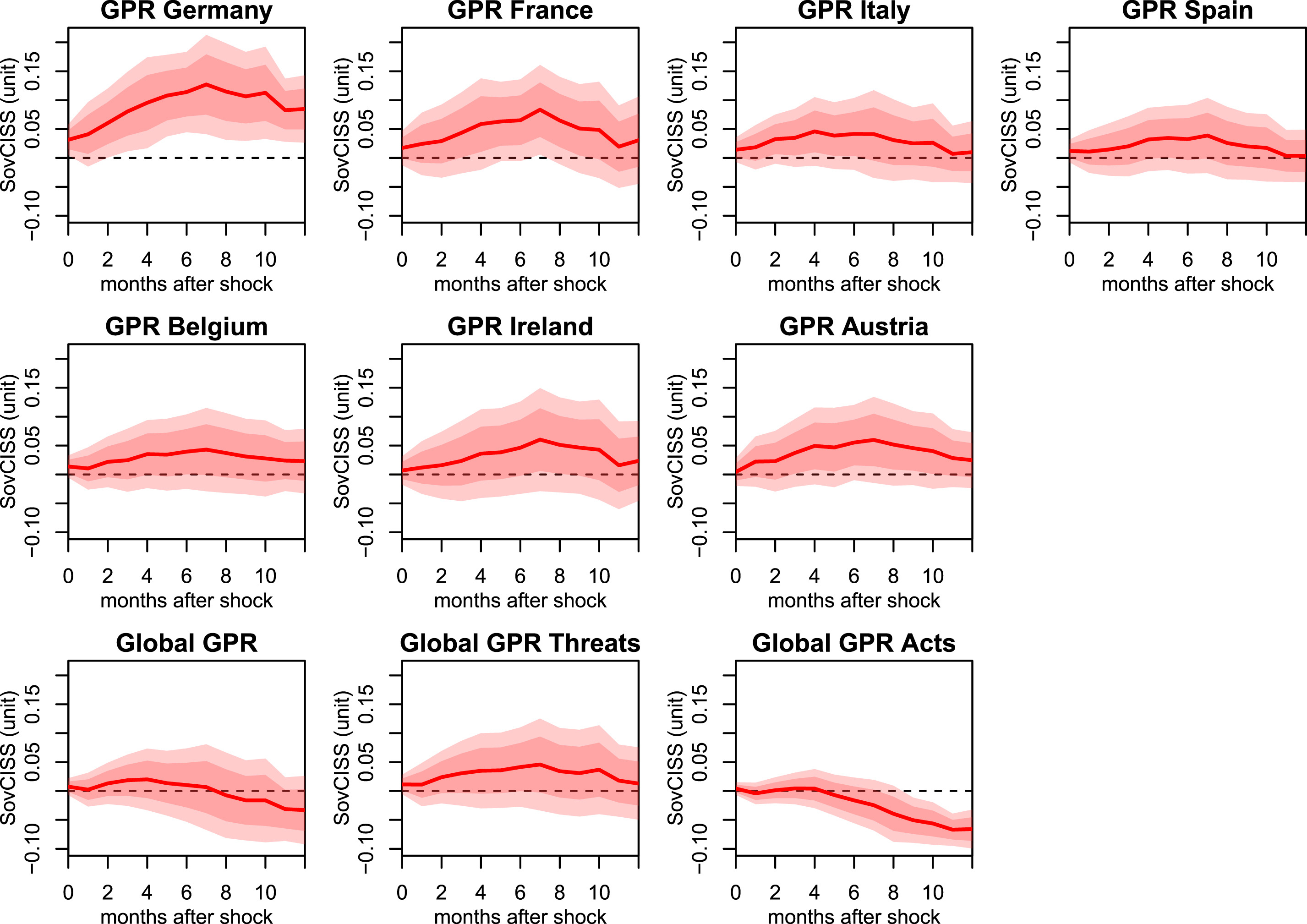
The German response reaches approximately 0.1 index units after five months and peaks slightly above that level. Its magnitude matches the rise in SovCISS observed between February and March 2022, providing an economic benchmark for the estimated effect.
Germany’s position offers an explanation for this transmission. German sovereign debt provides a pricing benchmark, and the country occupies a central position in European production networks. Geopolitical uncertainty affecting its energy supply, industrial outlook, and fiscal commitments can therefore alter risk pricing across the monetary union.
The paper links this mechanism to Germany’s exposure to Russian energy before the invasion of Ukraine and the subsequent fiscal support measures. The estimated pattern is consistent with a risk-premium channel operating through uncertainty about energy costs, public finances, and growth. Results remain similar when countries receive equal weights in SovCISS, supporting the interpretation that Germany’s role extends beyond its weight in the aggregate.
The newspaper perspective matters
A country-specific geopolitical risk index reflects the sources used to construct it. German-language newspapers capture domestic perceptions of exposure to nearby conflicts, energy insecurity, and their economic consequences. Anglosphere-based reporting places different emphasis on geopolitical developments.
The paper documents unusually elevated German geopolitical risk during 2022–2024, following Russia’s invasion of Ukraine and during the Israel–Hamas conflict. It also compares the sovereign-stress responses obtained with local German and Anglosphere-based German GPR measures. The local-language measure produces the stronger estimated response.
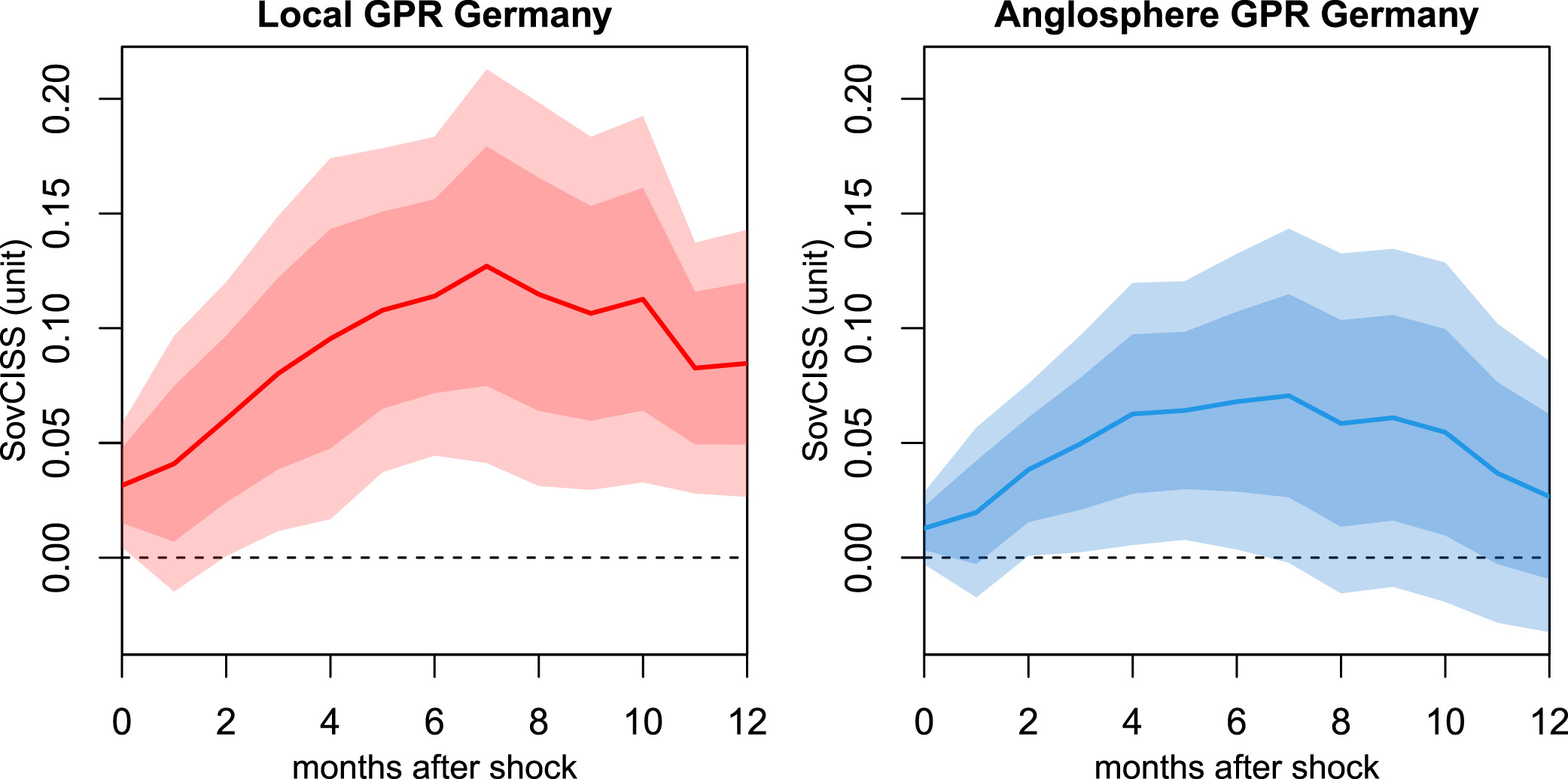
The contribution is to connect the national exposure to geopolitical risk, the media perspective used to measure it, and the response of sovereign debt markets. For euro-area surveillance, local-language indicators provide information about risks affecting a systemically important member of the monetary union.
Read the paper
Frangiamore, F., and Saadaoui, J. (2026). Local and Anglosphere-Based Geopolitical Risk and Sovereign Stress in the Euro Area. Finance Research Letters, 101, 110078. https://doi.org/10.1016/j.frl.2026.110078.
Published paper (PDF) · Journal article and supplementary material · R replication files
Selected references
Alonso-Alvarez, I., Diakonova, M., and Pérez, J. J. (2025). Rethinking GPR: The Sources of Geopolitical Risk. Banco de España.
Bondarenko, Y., Lewis, V., Rottner, M., and Schüler, Y. (2024). Geopolitical risk perceptions. Journal of International Economics, 152, 104005.
Caldara, D., and Iacoviello, M. (2022). Measuring geopolitical risk. American Economic Review, 112(4), 1194–1225.
Garcia-de Andoain, C., and Kremer, M. (2017). Beyond spreads: Measuring sovereign market stress in the euro area. Economics Letters, 159, 153–156.
Jordà, Ò. (2005). Estimation and inference of impulse responses by local projections. American Economic Review, 95(1), 161–182.
Two related EconMacro posts
Real-time Measure of Perception Divergence: France’s Political-Tension Situation illustrates how domestic and foreign media can convey different perceptions of political tensions. Using BBVA/GDELT indicators, it provides a complementary example of why the origin of news coverage matters.
Can Local Projections Have Short-Run Restrictions? explains how recursive restrictions identify geopolitical shocks and how local projections trace their effects over time.