Strong institutions usually reassure investors. The 2024 US presidential election revealed a different pattern: currencies of countries with stronger institutions depreciated more against the dollar, and the difference persisted over the following week.
Our paper, How Institutions Interact with Exchange Rates After the 2024 US Presidential Election: New High-Frequency Evidence, written with Joshua Aizenman, examines how a major political event changes the way markets price institutional exposure. It was published in Economics & Politics in 2026.
Read the published paper (PDF) · NBER working paper · VoxEU column
The dollar moves as election news arrives
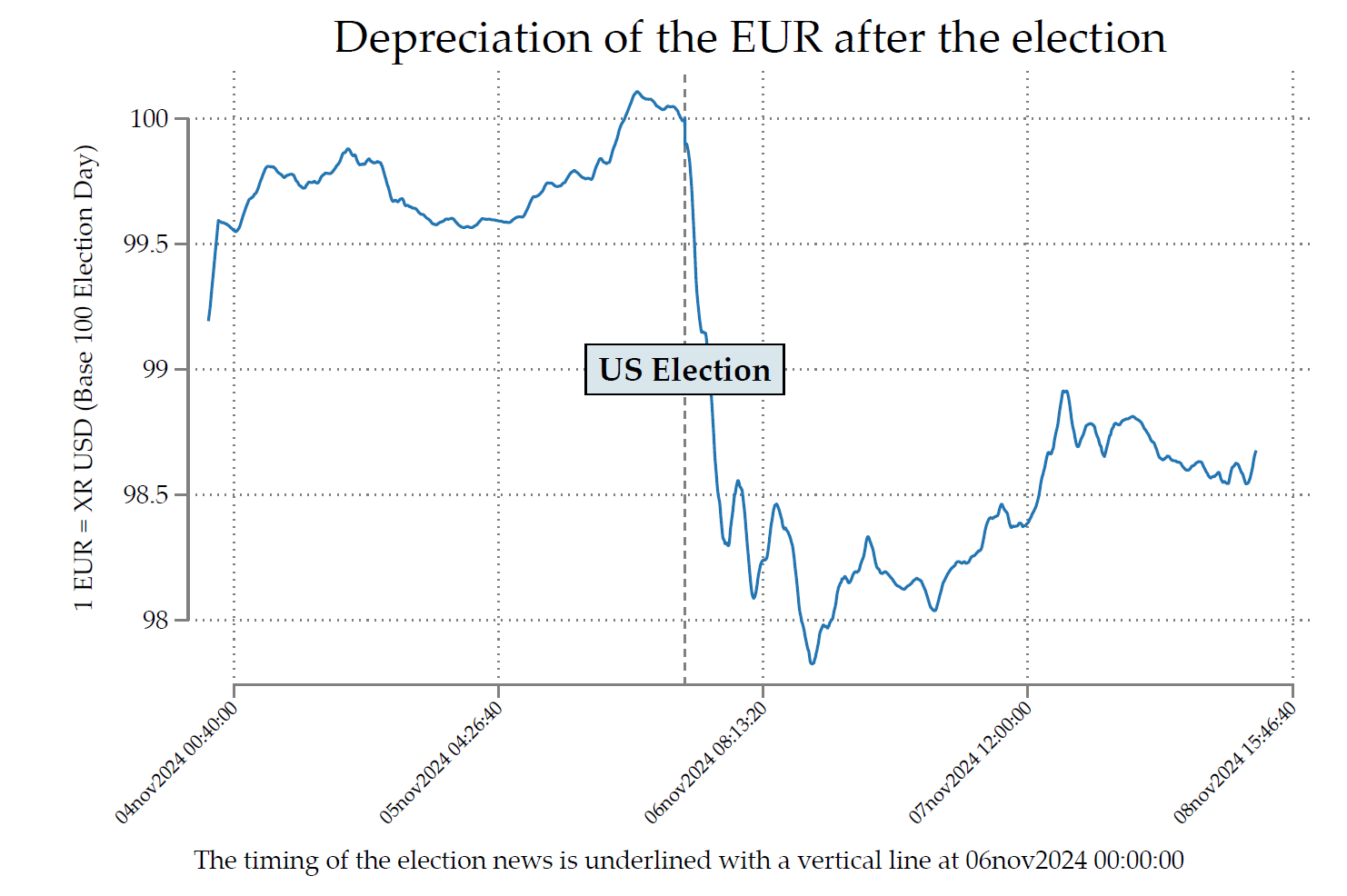
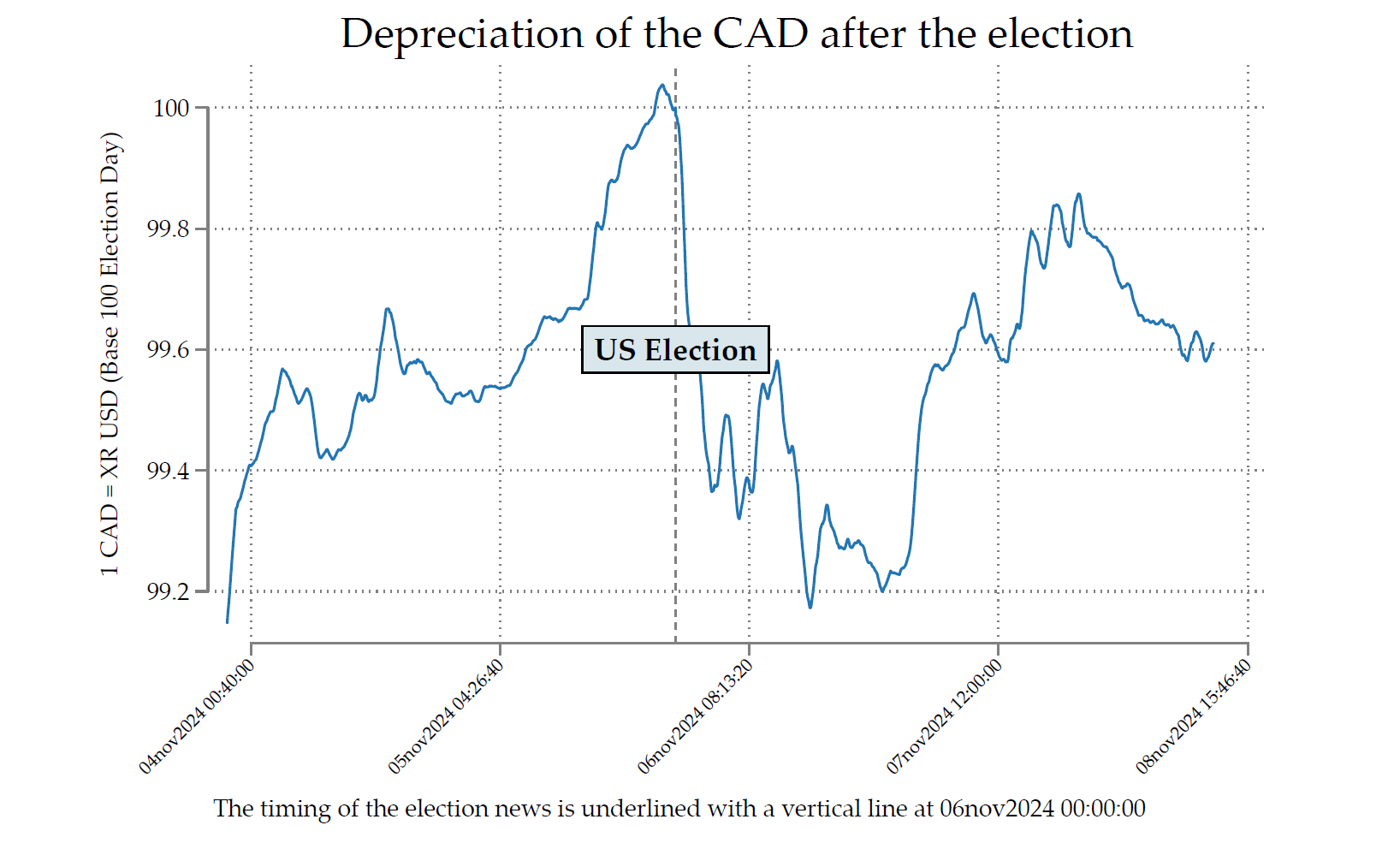
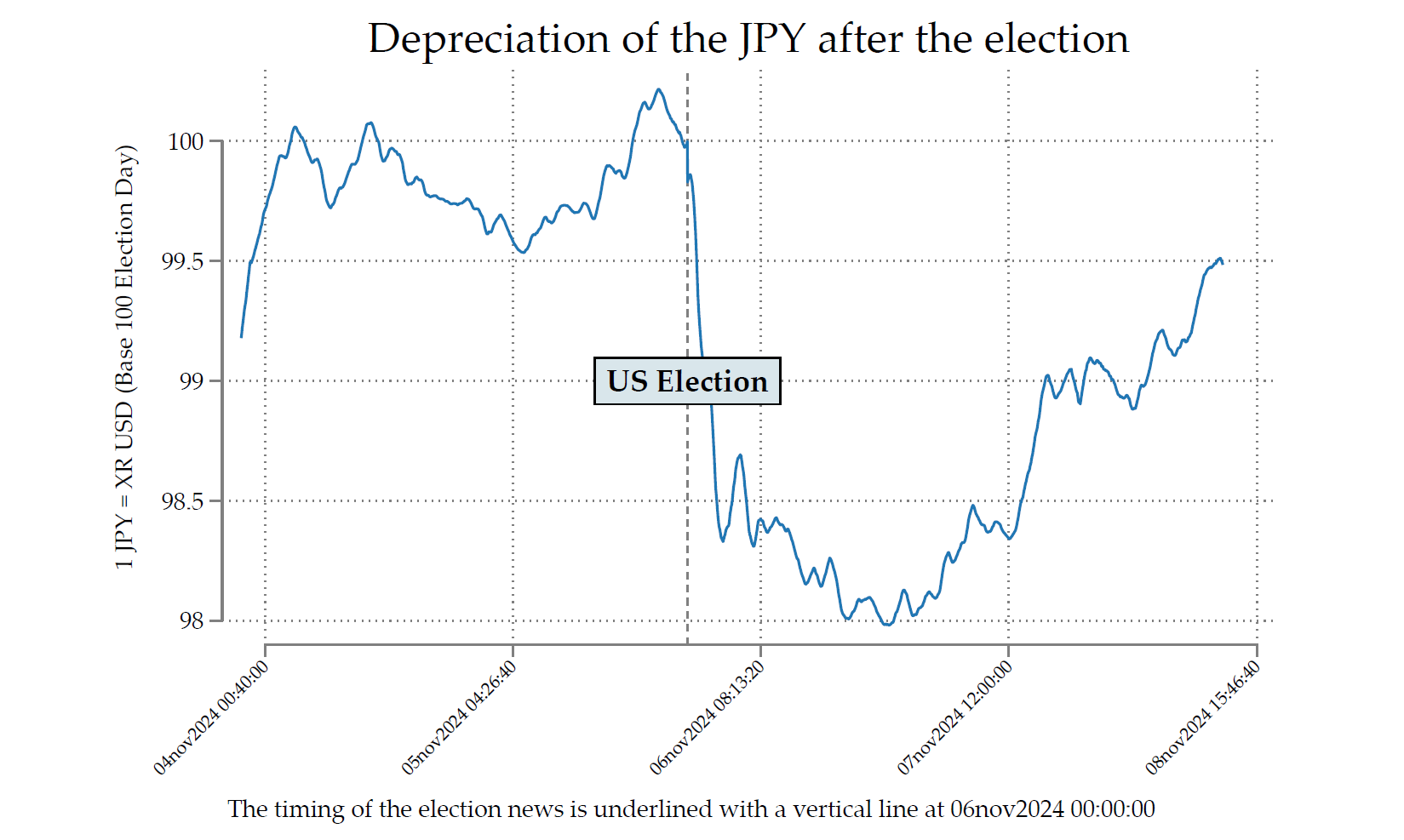
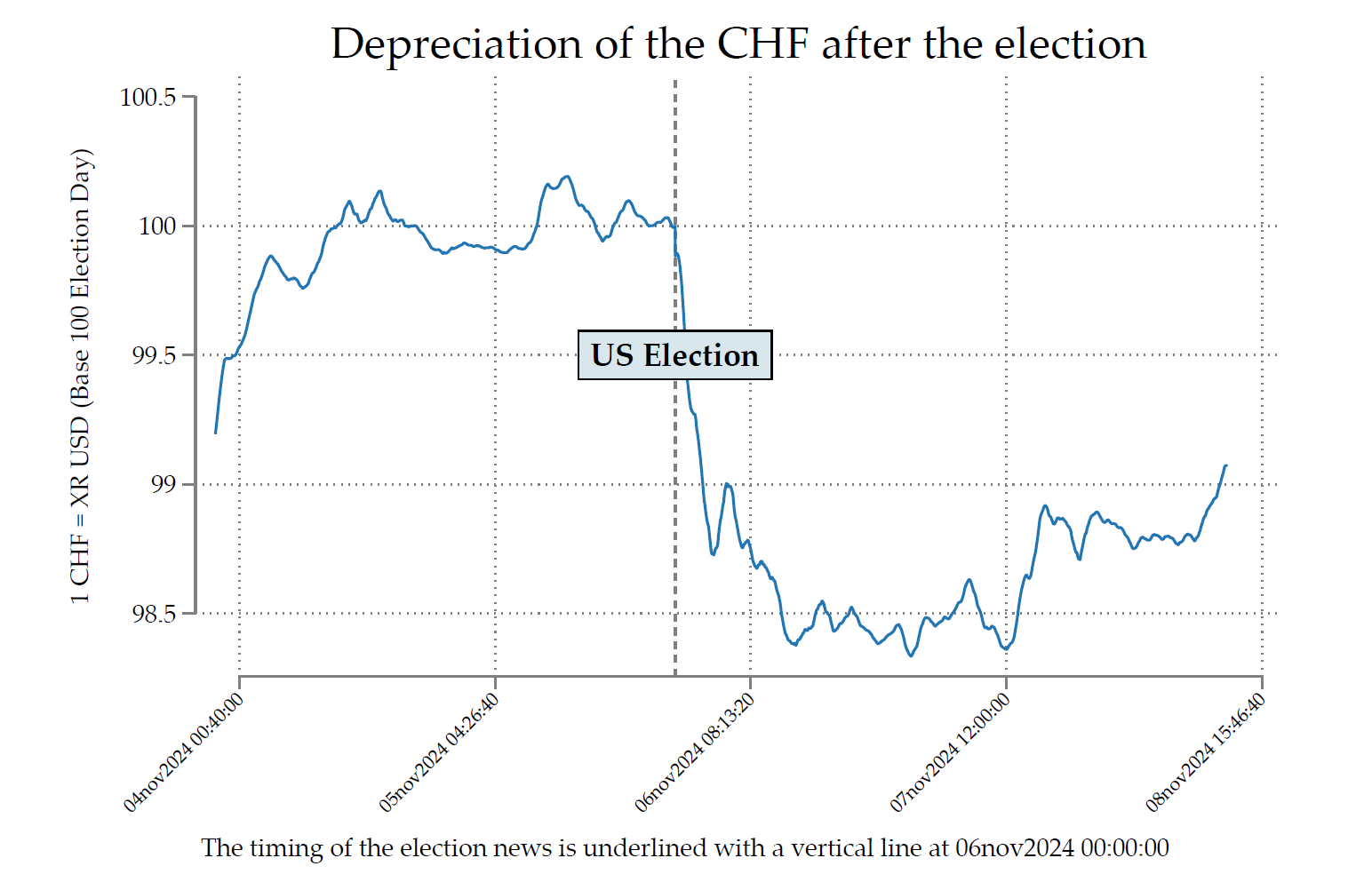
The four currency paths below show the common turning point around election night. The dollar strengthened against the euro, Canadian dollar, yen, and Swiss franc. The timing makes the information shock visible before we turn to differences across countries.
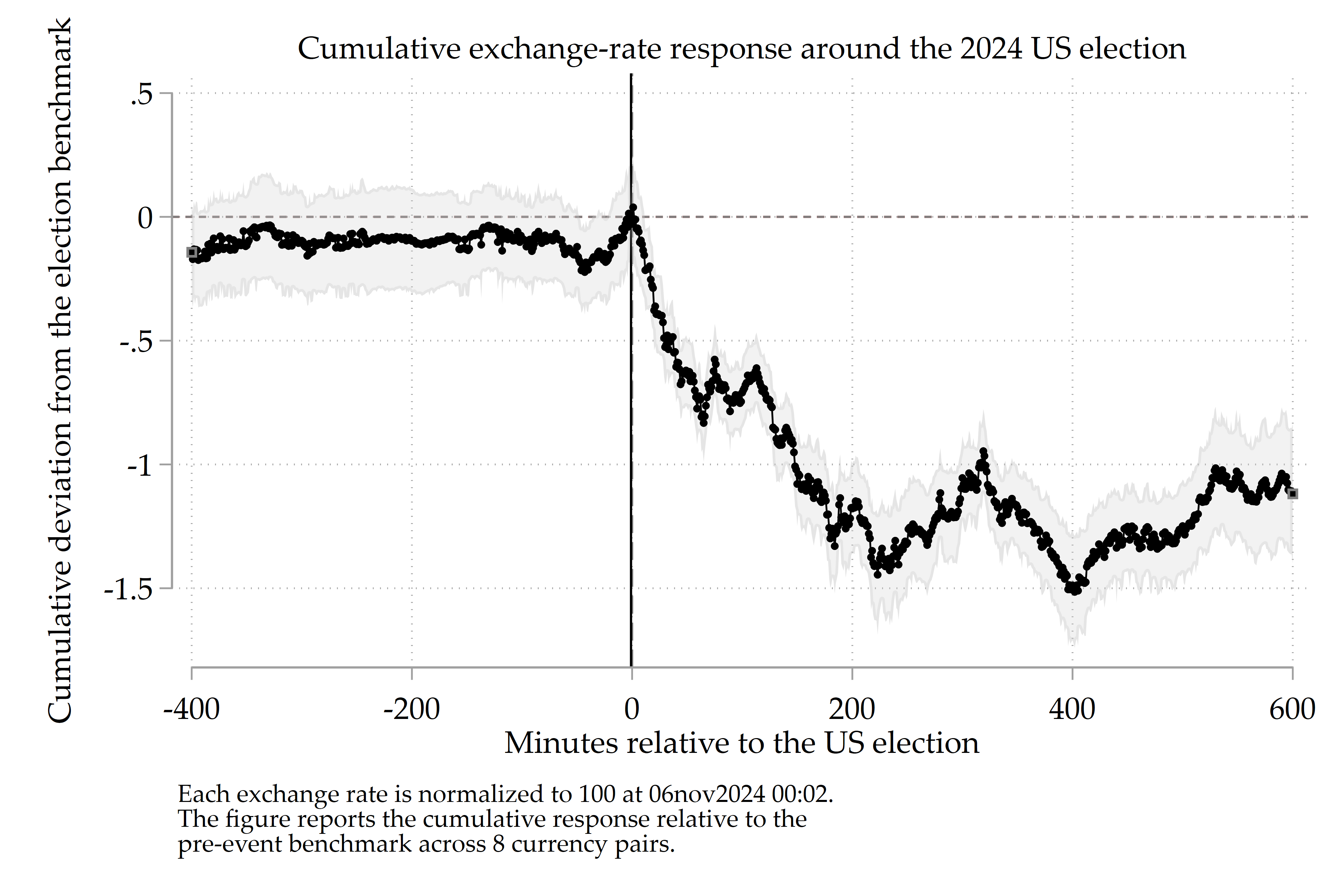
Following the adjustment minute by minute
An additional exercise using the same dataset pools eight currency pairs with currency-pair fixed effects. The response falls sharply after the event benchmark and remains negative over the following hours. In this figure, a negative response represents depreciation against the dollar.
Stronger institutions, greater depreciation
The paper then explains cross-country differences using pre-election characteristics. Its cross-sectional specification can be written as:
\[ d_i(h)=\alpha_h+\beta_h ICRG_i+ \boldsymbol{\gamma}_h^{\prime}\mathbf{X}_i+u_i(h). \tag{1} \]
Here, \(d_i(h)\) is percentage depreciation at the first-day maximum, after four days, or after one week. Higher \(ICRG_i\) means stronger institutions. The controls \(\mathbf{X}_i\) cover exchange-rate stability, REER misalignment, capital-account openness, the current-account balance, and the bilateral trade balance with the US. Identification rests on the unexpected election news and predetermined country characteristics.
In the baseline multivariate specification, a ten-point higher institutional score is associated with 0.65 percentage point greater depreciation after one week. The institutional coefficient is positive at all three horizons.
Which institutional dimensions matter?
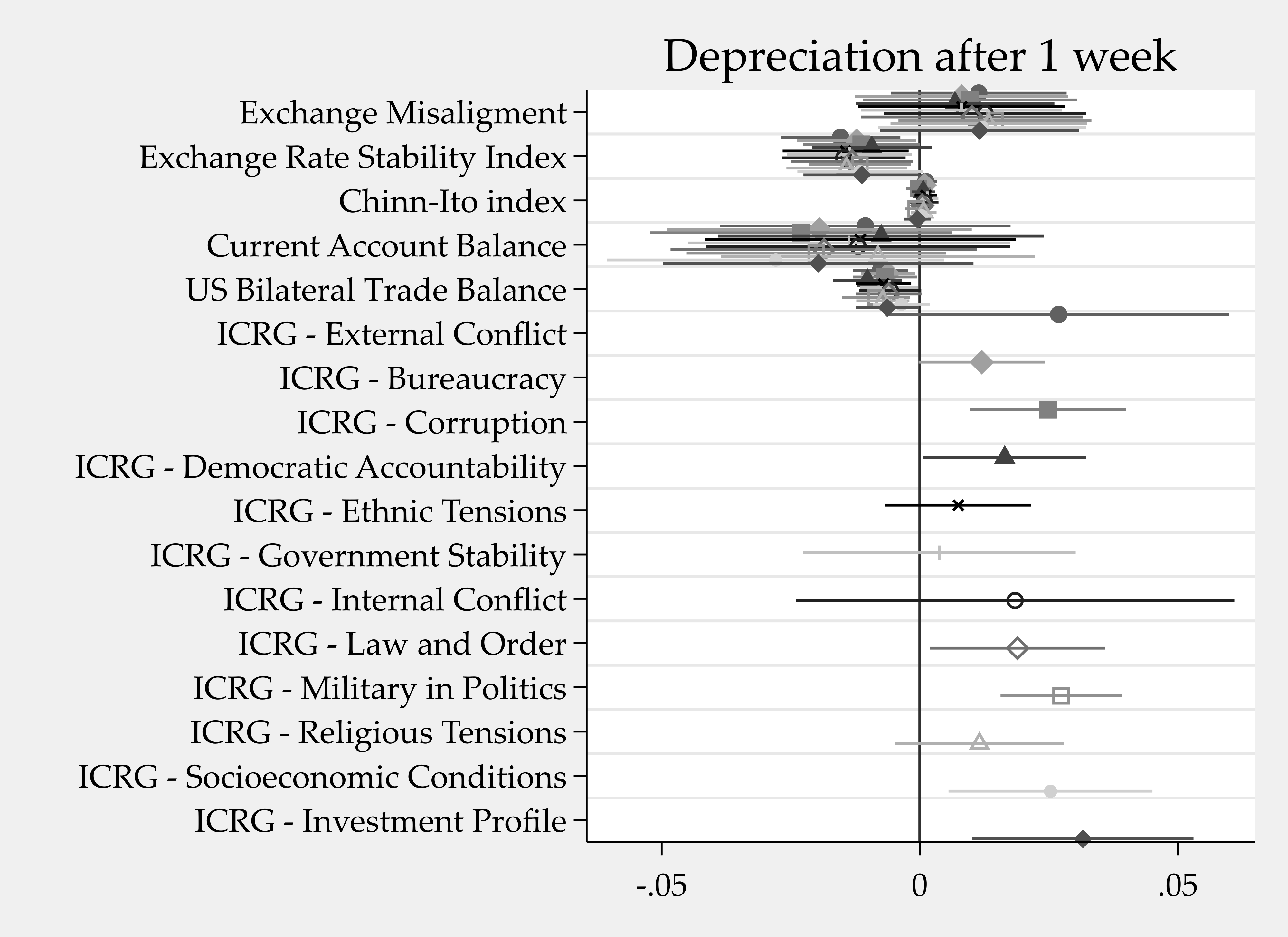
The following plots unpack the aggregate score through twelve separate specifications. Positive institutional coefficients indicate greater depreciation. Each ICRG component is scored so that higher values indicate lower risk: a positive corruption-score coefficient therefore refers to better corruption control.
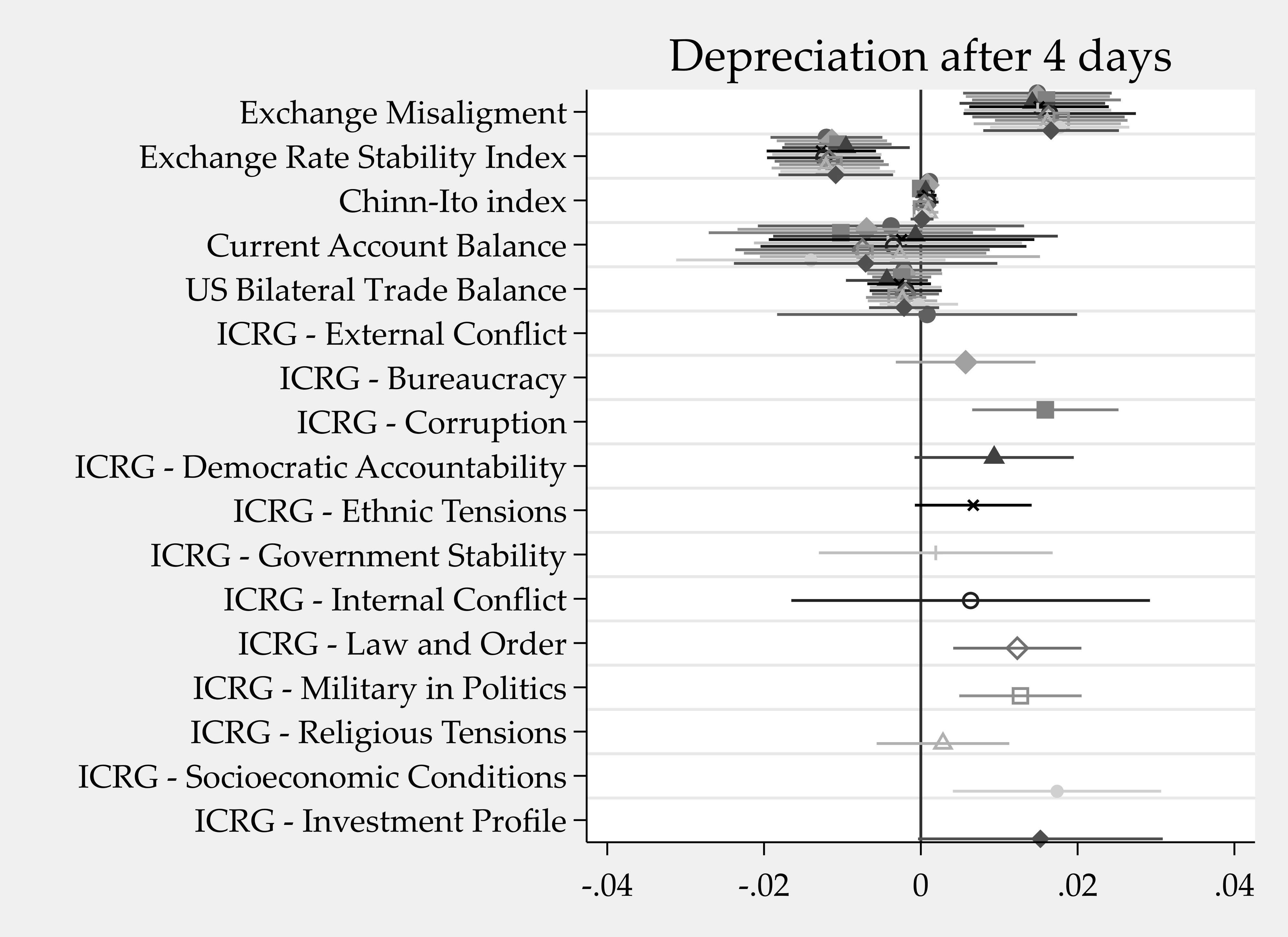
Corruption control, limited military involvement in politics, and stronger socioeconomic conditions emerge across the three horizons. Law and order matters after four days and one week; democratic accountability and investment profile also matter at the weekly horizon.
When geopolitical alignment changes market exposure
Our interpretation centres on expectations about US policy. Countries with strong institutions had benefited from an international order built around predictable rules, alliances, and policy coordination. A shift towards more transactional relations could reduce those expected benefits and increase uncertainty about their future access to cooperation and support.
Markets could therefore reassess exposure along institutional lines. The currency response captures this reassessment as investors update their expectations about trade and foreign policy. The VoxEU column develops this geopolitical interpretation and its policy implications.
Two related EconMacro posts
My post Using Stata, Python, and BIS Daily to Watch Exchange Rate Behavior after the US 2024 Presidential Election shows how to download and plot BIS daily exchange rates, extending the visual exploration beyond the immediate election window.
My post Using coefplot to visualize the results of several models with Stata explains how the institutional-component regressions are estimated and displayed together. It provides the Stata workflow behind this comparison.
Read the paper
The contribution is to connect the timing of a global political shock with the institutional characteristics that shape its international financial transmission. The election illustrates how expectations about the global policy environment can change the market value of institutional alignment.
Aizenman, J., and Saadaoui, J. (2026). How Institutions Interact with Exchange Rates After the 2024 US Presidential Election: New High-Frequency Evidence. Economics & Politics, 38(3), 679–693. https://doi.org/10.1111/ecpo.70047.
Published paper (PDF) · NBER Working Paper No. 33193 (PDF) · VoxEU column