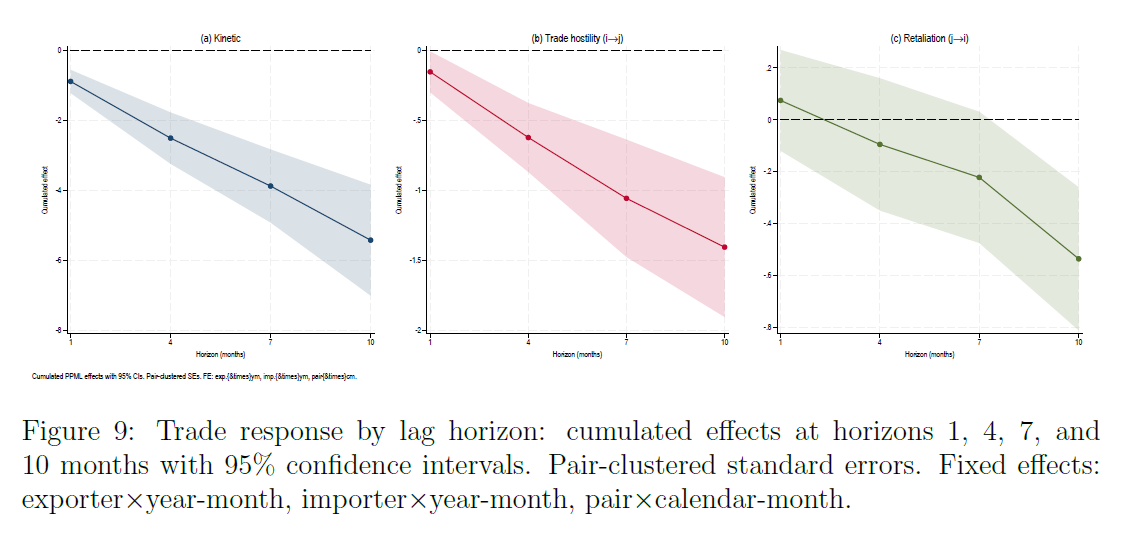
NEW WORKING PAPER: How damaging is a “trade war” compared to a “military war” or a “war of words”? Aggregate conflict indicators cannot say, because they treat missile strikes, sanctions, and diplomatic protests as equivalent. We build a monthly bilateral indicator from GDELT event data, calibrated against human-curated ground truth, that decomposes hostility into four layers: kinetic fighting (“military war”), military posture, sanctions-context tensions (“trade war”), and routine diplomacy. The decomposed panel reveals a secular shift: over the past decade, governments have steadily substituted economic coercion for military confrontation, nearly doubling the trade-weighted share of hostility channelled through sanctions contexts. In a gravity trade model, the aggregate indicator is negative, large, and statistically significant, but the decomposition reveals that only two layers drive the result. Kinetic conflict and trade-context hostility are both economically large and precisely estimated; routine diplomacy, despite dominating measured hostility, has no trade effect at all. The directed structure uncovers a retaliation channel that compounds trade losses over several months. Our measure remains a robust determinant of international trade in a horse race against closest alternative bilateral indicators. Relative to a pre-escalation baseline, the geopolitical deterioration of the past decade has put roughly $334 billion of bilateral trade at risk, with the US–China pair accounting for half.
You are welcome to download, share, or comment on the following working paper:
- Joshua Aizenman, Rodolphe Desbordes, Jamel Saadaoui, (April 20, 2026), Bilateral Conflict Risk and Trade: Military Wars, Trade Wars, and Diplomatic Noise. NBER Working Paper w35077.