Geopolitics affects oil prices through expectations about both demand and supply. Our paper shows that better US–China political relations and higher China-related geopolitical risk can both raise oil prices, through different economic channels.
Written with Valérie Mignon, How Do Political Tensions and Geopolitical Risks Impact Oil Prices? was published in Energy Economics in 2024. The baseline analysis uses monthly data from January 2000 to December 2019, combining structural VARs and local projections.
The central distinction concerns the information conveyed by political news. Improved bilateral relations support expectations of economic activity and oil demand. Higher geopolitical risk also reflects fears of disruptions to oil supply. The two indicators therefore provide complementary information about oil-price dynamics.
Published paper (PDF) · Journal article · Replication code and data
The estimated equations
The Political Relationship Index (PRI), constructed at Tsinghua University, increases when US–China relations improve. It enters the model through the log-modulus transformation \(z_t=\operatorname{sgn}(\mathrm{PRI}_t)\log(1+|\mathrm{PRI}_t|)\). In a separate specification, \(z_t\) is replaced by the China-specific Geopolitical Risk Index (GPR), which measures adverse geopolitical news involving China in US newspapers.
Let \(\mathbf y_t=(z_t,\log Q_t,\log A_t,\log P_t)’\), where \(Q_t\) is global oil production, \(A_t\) is world industrial production, and \(P_t\) is the real WTI oil price. The structural VAR contains 24 monthly lags:
Recursive identification orders the political indicator first, followed by oil production, industrial production, and the real oil price. Political shocks can affect oil-market variables within the month; feedback from the oil market to the political indicator operates with a lag. Structural shocks are recovered from the reduced-form residuals \(\mathbf u_t\) as \(\boldsymbol{\varepsilon}_t=\mathbf B^{-1}\mathbf A\mathbf u_t\).
For the oil-price response, the local-projection equation can be written compactly as:
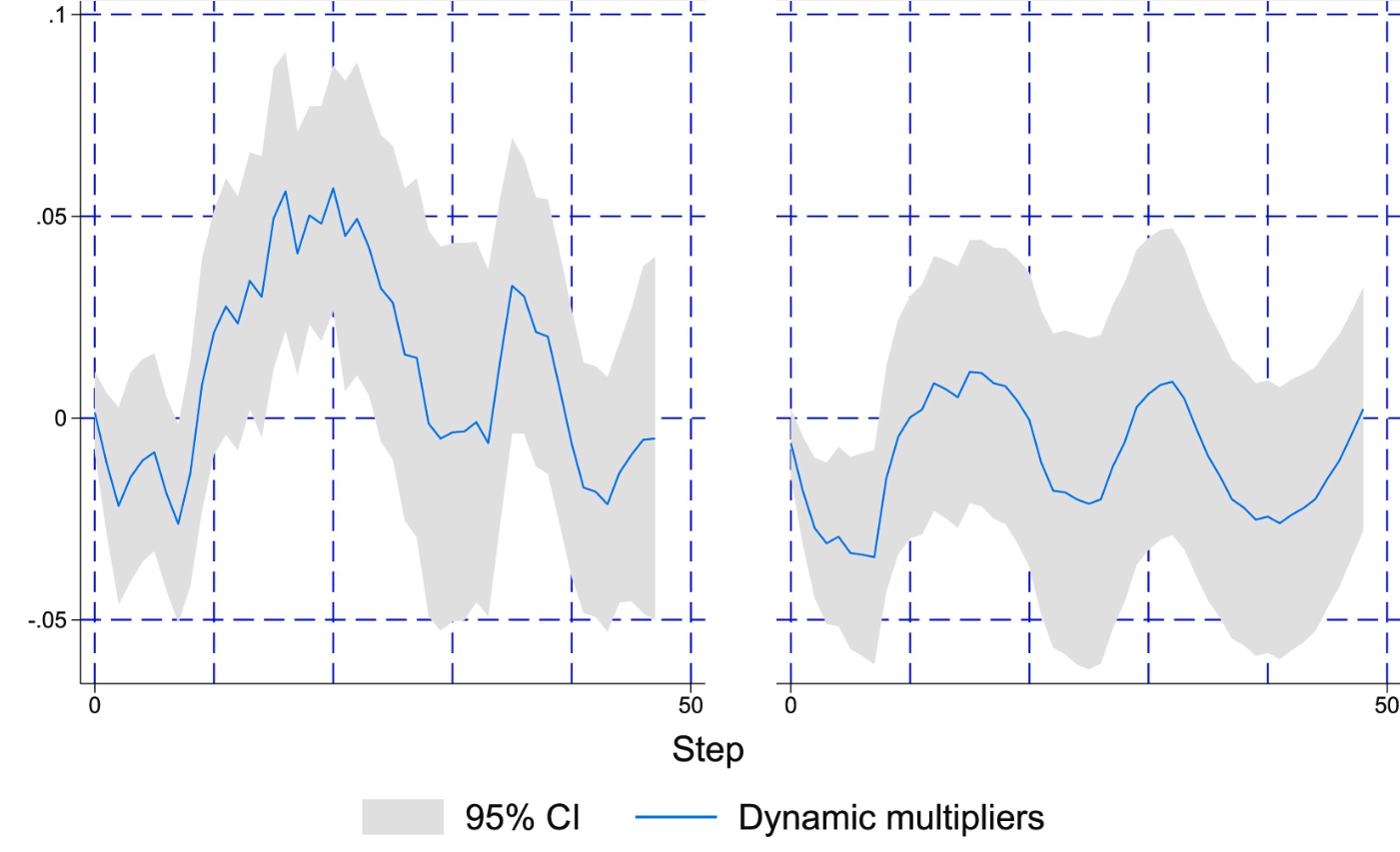
Here, \(\widehat{\varepsilon}^{\,z}_t\) is the identified PRI or GPR shock. The controls \(\mathbf W_t\) include 24 lags of the shock and the oil-market variables. The coefficient \(\beta_h\) measures the response of the log real oil price at horizon \(h\). The figures compare these local-projection dynamic multipliers with their VAR counterparts.
Better political relations support expected oil demand
An unexpected improvement in US–China relations strengthens the outlook for economic activity. The local projections show a positive oil-price response after approximately 13 months, lasting about 10 months. The paper links this response to more optimistic demand expectations.
Higher geopolitical risk raises supply concerns
A positive China GPR shock produces a positive oil-price response after approximately 8 months, lasting around 18 months in the local projections. The paper interprets this persistence through expectations that geopolitical conflict could disrupt oil supply. China GPR captures a broader range of geopolitical events involving China than the bilateral relationship measured by PRI.
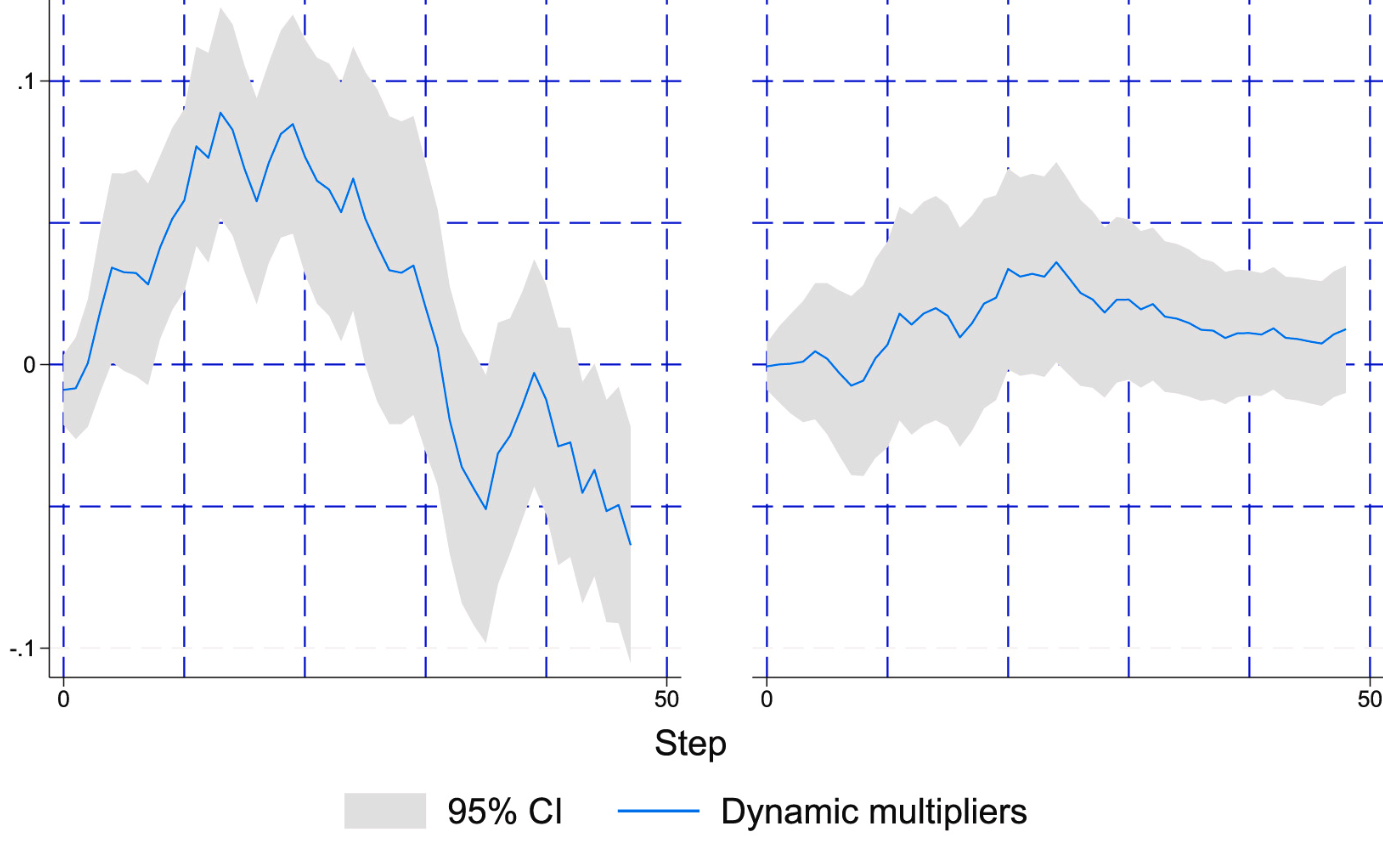
In both baseline figures, statistical support for a positive oil-price response comes from the local projections.
Expectations connect political news to oil prices
The paper also reports time-varying Granger-causality tests using OECD consumer confidence, business confidence, and composite leading indicators. PRI improves forecasts of consumer expectations more frequently; GPR has stronger predictive links with business expectations and aggregate economic prospects. These findings support the distinction between demand expectations and supply concerns.
For the interpretation of geopolitical developments, the implication is to consider both the quality of bilateral relations and the risks surrounding supply. Each conveys information relevant to the oil market.
Two related EconMacro posts
My post Illustrating the New LPIRF Stata 18’s Command explains how to recover structural shocks from a recursively identified VAR and use them in Stata’s lpirf command. It provides code comparing local-projection and VAR dynamic multipliers for political relations and China-related geopolitical risk.
My companion post When US–China Tensions Lower Oil Prices revisits the historical finding with updated data and direct local projections. It extends the analysis to directed geopolitical-risk indices, distinguishing news about tensions initiated by China toward the United States from news in the opposite direction, and examines how responses vary across sample periods.
Paper and replication
Mignon, V., and Saadaoui, J. (2024). How do political tensions and geopolitical risks impact oil prices? Energy Economics, 129, 107219. DOI.