I started the EconMacro Research Briefs so that anyone with five minutes to spare can explore the economic questions my coauthors and I study. Each brief uses a figure to explain one finding in plain language, with a link to the paper for readers who want to go further.
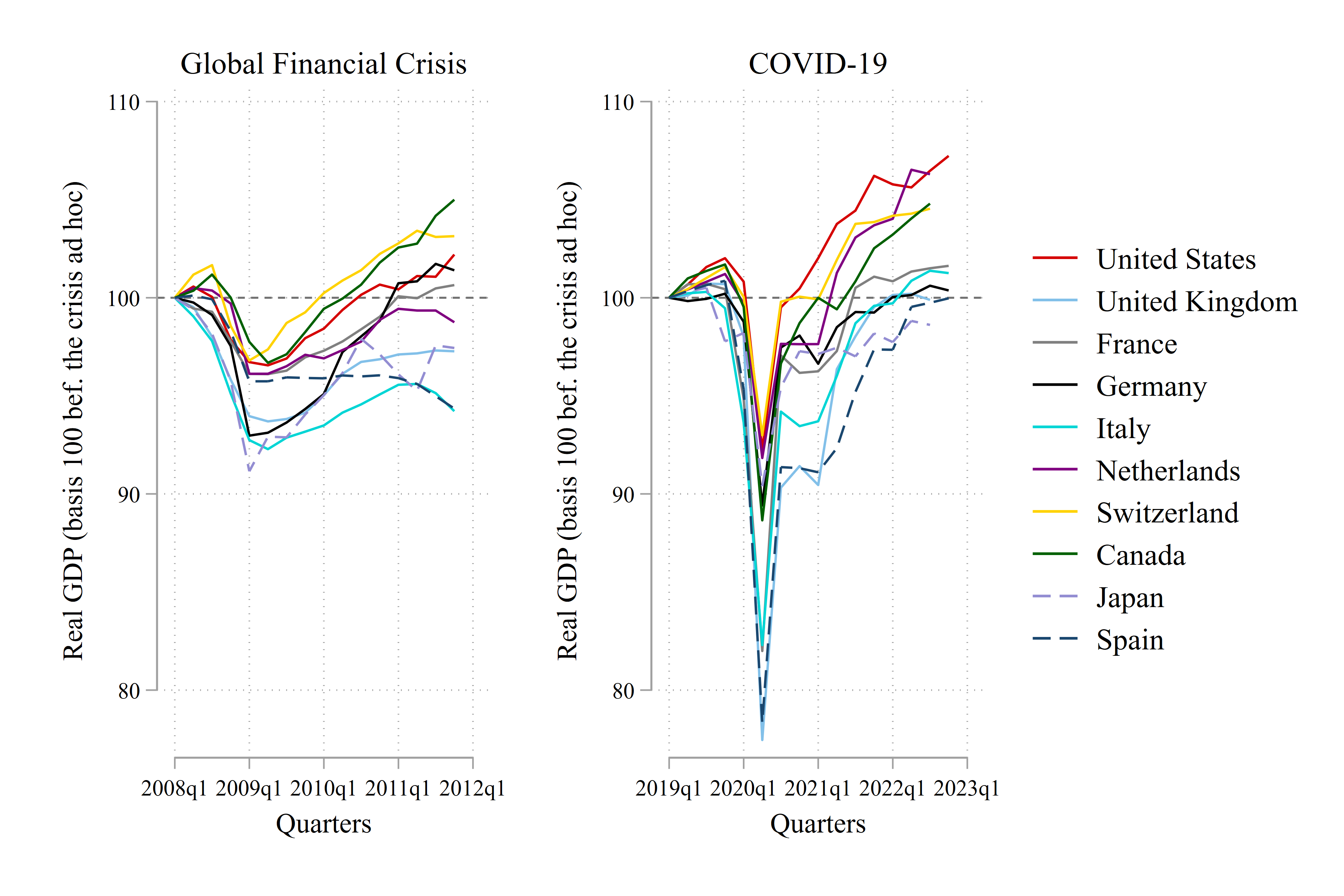
Spain’s economy fell much further during the pandemic than during the global financial crisis. Yet it bounced back faster. How much does the depth of a recession tell us about the recovery that follows?
Try it with the chart below. Find Spain in each panel and follow its line from the bottom of the recession. After the financial crisis, output was still below its early-2008 level at the end of 2011. After the pandemic struck, the line turns up sharply. In When Do Deep Recessions Lead to Strong Recoveries? (Brief 13), we look at 419 recessions and find that deeper falls generally precede stronger rebounds. That relationship weakens where trade is more restricted.
What does political news do to prices?
Two briefs ask why oil traders respond to diplomacy. In Geopolitical Turning Points and Oil Prices (Brief 2), an improvement in US–China relations initially lowers oil prices, then raises them as the outlook for demand improves. Geopolitics and Oil Prices (Brief 7) explores a puzzle. Both better diplomatic relations and bad geopolitical news about China can lift oil prices. One points to stronger demand, the other to fears about supply.
Copper offers another surprise. In Copper Prices Under Geopolitical Pressure (Brief 10), copper prices respond more strongly to geopolitical threats than to geopolitical acts. For a different perspective, Geopolitical Risk and Monetary Policy (Brief 8) follows central banks through the months after a geopolitical shock. An initial easing gives way to higher interest rates a year later.
What protects a currency?
During the 2021–22 dollar surge, countries that had built up larger foreign exchange reserves generally saw their currencies fall less. FX Reserves and the Dollar Surge (Brief 3) follows that episode. When Do International Reserves Cushion the Real Exchange Rate? (Brief 12) looks at pressure in the other direction. When a country’s exports buy more imports, reserve holdings can temper the rise in its real exchange rate.
Election night offers a closer look at how fast currencies move. Strong Institutions, Weaker Currencies (Brief 5) tracks currencies minute by minute on the night of the 2024 US election, then asks why countries with stronger institutions saw larger depreciations against the dollar. In International Loans and the Geopolitics of Credibility (Brief 9), the news is a loan from the IMF or the Asian Development Bank. We follow the currency to see how markets respond when the borrower temporarily holds a seat on the UN Security Council.
Which risks show up in investment and borrowing costs?
An average forecast can hide what matters to a business planning its next investment. In Geopolitical Risk and U.S. Investment-at-Risk (Brief 1), a 30-point rise in the geopolitical risk index lowers predicted investment growth next quarter by just 0.15 percentage points on average. At the weak end of the forecast, the same rise lowers predicted growth by 1.8 percentage points. That gap is easy to miss if you look only at the headline number.
German Geopolitical Risk and Euro Area Sovereign Stress (Brief 4) follows a signal from German-language newspapers into government bond markets across the euro area. Climate Vulnerability and the Sovereign Risk Premium (Brief 6) asks why rising climate vulnerability makes borrowing more expensive for some governments. The increase in borrowing costs is larger where religious tensions run higher, while stronger financial institutions provide a buffer.
When does research pay off?
Stability and the Returns to R&D (Brief 11) asks why a similar research effort can go hand in hand with different income levels across countries. Across the countries we study, the link between research intensity and income per person is stronger where governments are more stable and religious tensions are lower.
If you have five minutes, browse the EconMacro Research Briefs and pick the question you’d most like to answer. I’d love to hear which figure made you look twice.