An international loan carries information about the recipient’s economic prospects and the political considerations behind the funding decision. Exchange rates reveal how financial markets assess that information, and how their assessment changes over time.
Our paper, Exchange rate reaction to international organization loans and geopolitical preferences, written with Hugo Oriola and published in Economics Letters, studies this relationship for IMF and Asian Development Bank (ADB) lending. The analysis combines monthly exchange rates, temporary membership of the United Nations Security Council, institutional quality, and geopolitical preferences measured through UN voting.
The central finding is that the currency response depends on both the horizon and the recipient’s geopolitical position. For temporary Security Council members, IMF lending produces an initial depreciation followed by an appreciation at the twelve-month horizon. ADB lending produces an earlier appreciation, around month four. The specification incorporating geopolitical distance from China reveals a particularly strong appreciation response to ADB lending.
Read the published article · Read the open-access paper (PDF)
International lending and the credibility signal
International financing can have a catalytic effect: official support improves confidence in the recipient’s prospects and encourages private financing. A loan announcement can also draw attention to economic difficulties or to political considerations behind the allocation of funds. The exchange-rate response reflects the market’s assessment of these signals.
Temporary membership of the United Nations Security Council (UNSC) provides a setting in which a country’s strategic importance changes. The paper follows the literature that treats this membership as quasi-random political variation. The membership indicator covers the two-year mandate and the preceding six months, allowing for effects associated with the forthcoming term.
The underlying unbalanced panel covers 153 countries from February 1993 to December 2019, with 37,440 available monthly exchange-rate observations. The analysis focuses on floating exchange-rate regimes. IMF lending information comes from the Monitoring of Fund Arrangements database; the ADB sovereign-loan series begins in 1997.
From initial depreciation to subsequent appreciation
The local projections relate future monthly exchange-rate growth to the interaction between a loan indicator and UNSC membership. For institution \(P\), the baseline specification is:
The indicator \(Loan^P_{i,t}\) equals one when institution \(P\) grants funding in country \(i\) during month \(t\). The control vector \(\boldsymbol{C}_{i,t}\) contains CPI inflation and the twelve contemporaneous ICRG institutional components, including government stability, corruption, internal conflict, and democratic accountability. Country and time fixed effects absorb persistent national characteristics and common time shocks. Standard errors are clustered by country.
The outcome \(FX_{i,t+h}\) is the monthly growth rate of the bilateral exchange rate against the US dollar at horizon \(h\). A positive response indicates depreciation; a negative response indicates appreciation. Each estimate describes the change in monthly exchange-rate growth at the specified horizon.
| Lending institution | Horizon | Approximate response | Direction |
|---|---|---|---|
| IMF | 2 months | +2 percentage points | Depreciation |
| IMF | 12 months | −2 percentage points | Appreciation |
| ADB | 4 months | −0.25 percentage points | Appreciation |
The responses are measured in percentage points of monthly exchange-rate growth following a unit change in the loan–membership interaction.
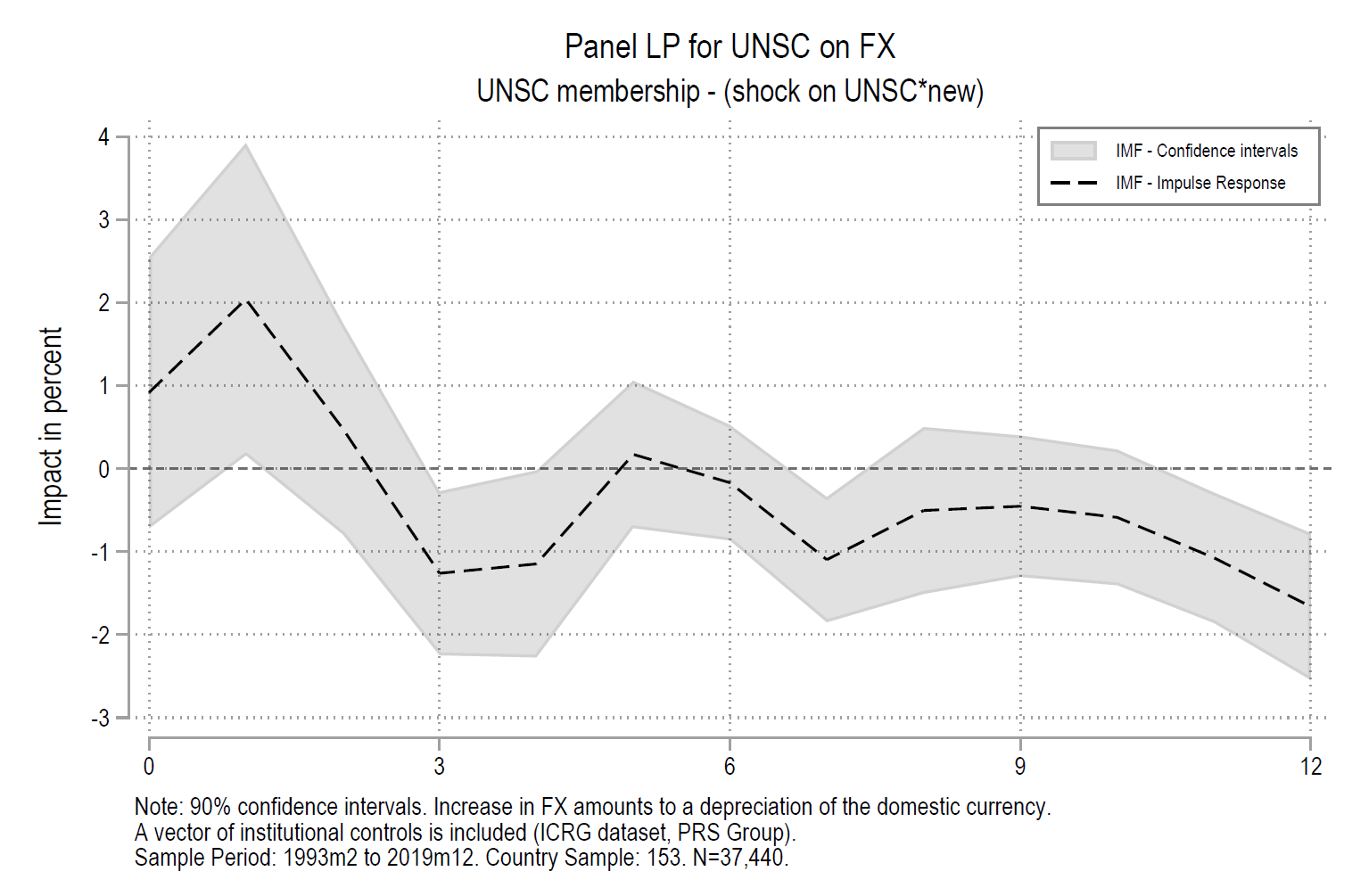
The IMF response changes sign over the projection horizon. The depreciation of approximately two percentage points at month two is followed by an appreciation of similar magnitude at month twelve. This timing is central to the paper’s contribution: the initial market response and the subsequent catalytic effect emerge at different horizons.
For ADB lending, the baseline appreciation appears earlier and reaches approximately 0.25 percentage points at month four. Institutional quality also contains relevant information: the paper reports that a better internal-conflict score, indicating less conflict, is associated with appreciation throughout the projection horizon.
How geopolitical preferences enter the response
Geopolitical preferences are measured using the UN General Assembly ideal points developed by Bailey, Strezhnev, and Voeten (2017). The distance from a reference country \(H\) is the absolute difference between its ideal point and that of the recipient. The paper uses the average distance over the preceding twelve months:
A larger value of \(D^H_{i,t}\) indicates weaker geopolitical alignment with country \(H\). The extended specification incorporates this distance into the lending–membership interaction:
The coefficient \(\theta_h\) is the response per unit of the triple interaction. During the membership window, the fitted contribution of a loan approval therefore scales with geopolitical distance. The reference countries are examined in separate specifications.
The ADB results make this geopolitical dimension particularly visible. In the specification involving distance from China, the appreciation response at months three and four is approximately four times the baseline magnitude, as reported in the paper. The corresponding specification involving distance from the United States produces a weaker peak appreciation, around 0.10 percentage points.
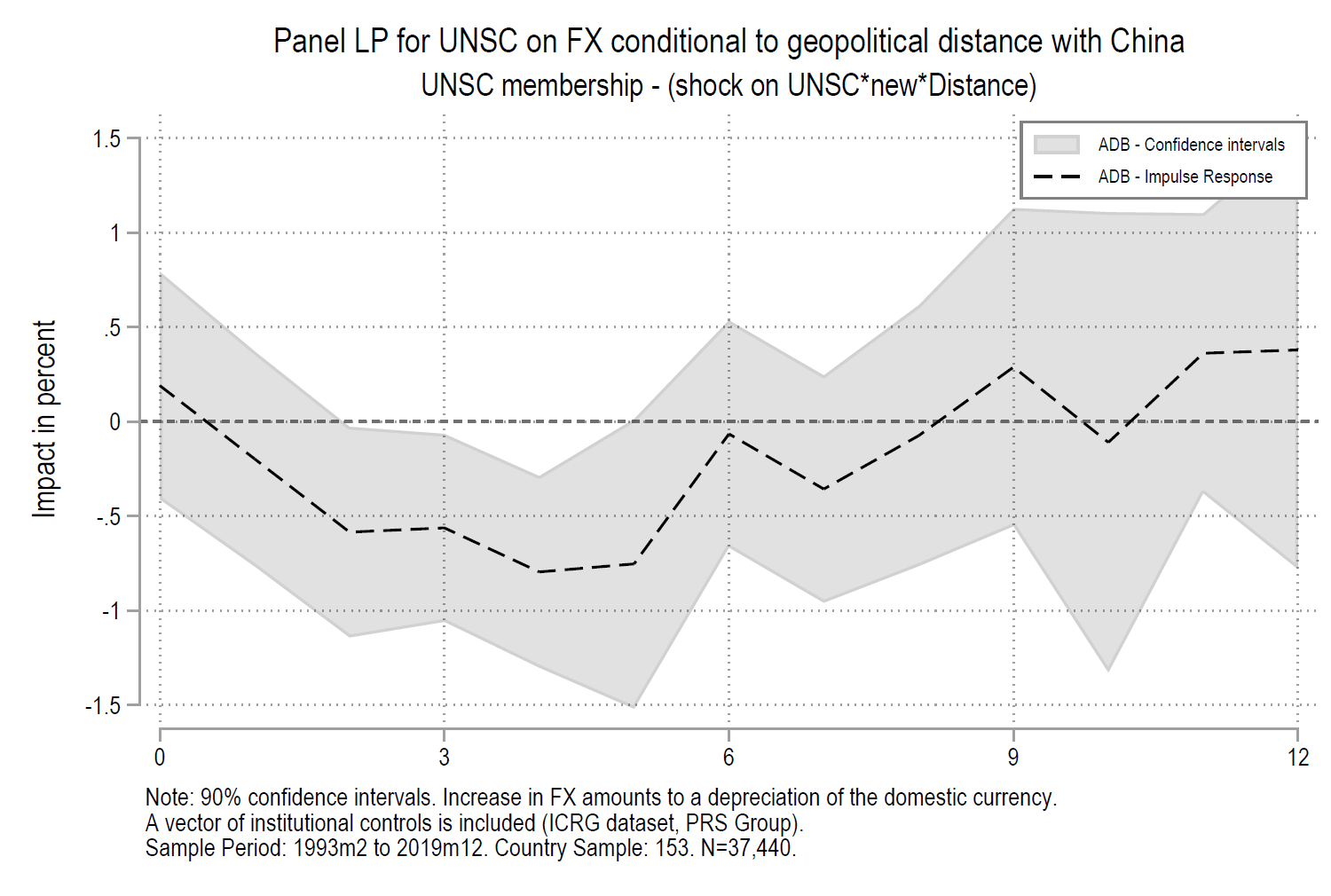
The paper interprets this pattern as a credibility channel. Official financing can provide a stronger signal about economic prospects when markets perceive the allocation as less closely connected to geopolitical proximity. Investor confidence and the attraction of private financing provide the economic interpretation of the exchange-rate evidence.
The IMF estimates also show that geopolitical preferences matter. Greater distance from the United States is associated with a weaker twelve-month appreciation in the interaction specification, while the specification involving distance from China retains a sizeable appreciation at that horizon.
Two related EconMacro posts
My post How do geopolitical interests affect financial markets reaction to international institution projects? introduces the broader research project with Hugo Oriola on international lending and its catalytic effects. It explains why the recipient country’s geopolitical preferences can shape how financial markets interpret support from international institutions.
My post Measuring friendliness and like-mindedness illustrates the measurement of geopolitical alignment using UN General Assembly voting distances and institutional similarity. It provides Stata code and visualizations comparing countries’ distance from the United States.
Read the paper
The contribution is to connect the dynamics of exchange rates after international lending to the geopolitical preferences of the recipient. The IMF results reveal a reversal from initial depreciation to later appreciation; the ADB results highlight an earlier response whose magnitude depends strongly on the geopolitical-distance specification.
The appendices report pre-global-financial-crisis and emerging-market estimates, specifications with interest differentials and additional interaction terms, and comparisons excluding the ICRG controls. Further exercises examine exchange-rate excess returns and 36-month-ahead economic growth. The excess-return analysis finds no clear-cut evidence of currency premia, while the growth analysis reports positive effects, especially for ADB lending and when distance from China is considered.
Oriola, H., and Saadaoui, J. (2025). Exchange rate reaction to international organization loans and geopolitical preferences. Economics Letters, 248, 112212. https://doi.org/10.1016/j.econlet.2025.112212.
Published article · Open-access paper and appendices (PDF)
Selected references
Andresen, L. L., and Sturm, J.-E. (2024). Do geopolitical interests affect how financial markets react to IMF programs? Review of International Political Economy, 31(1).
Bailey, M. A., Strezhnev, A., and Voeten, E. (2017). Estimating dynamic state preferences from United Nations voting data. Journal of Conflict Resolution, 61(2), 430–456.
Jordà, Ò. (2005). Estimation and inference of impulse responses by local projections. American Economic Review, 95(1), 161–182.