Climate vulnerability puts public finances under pressure through higher spending needs and weaker revenues. Our paper shows that the resulting sovereign risk depends on religious tensions and financial development.
Written with John Beirne, Donghyun Park, and Gazi Salah Uddin, Impact of Climate Vulnerability on Fiscal Risk: Do Religious Tensions and Financial Development Matter? was published in Energy Economics in 2026. The analysis covers around 100 countries over 1995–2019.
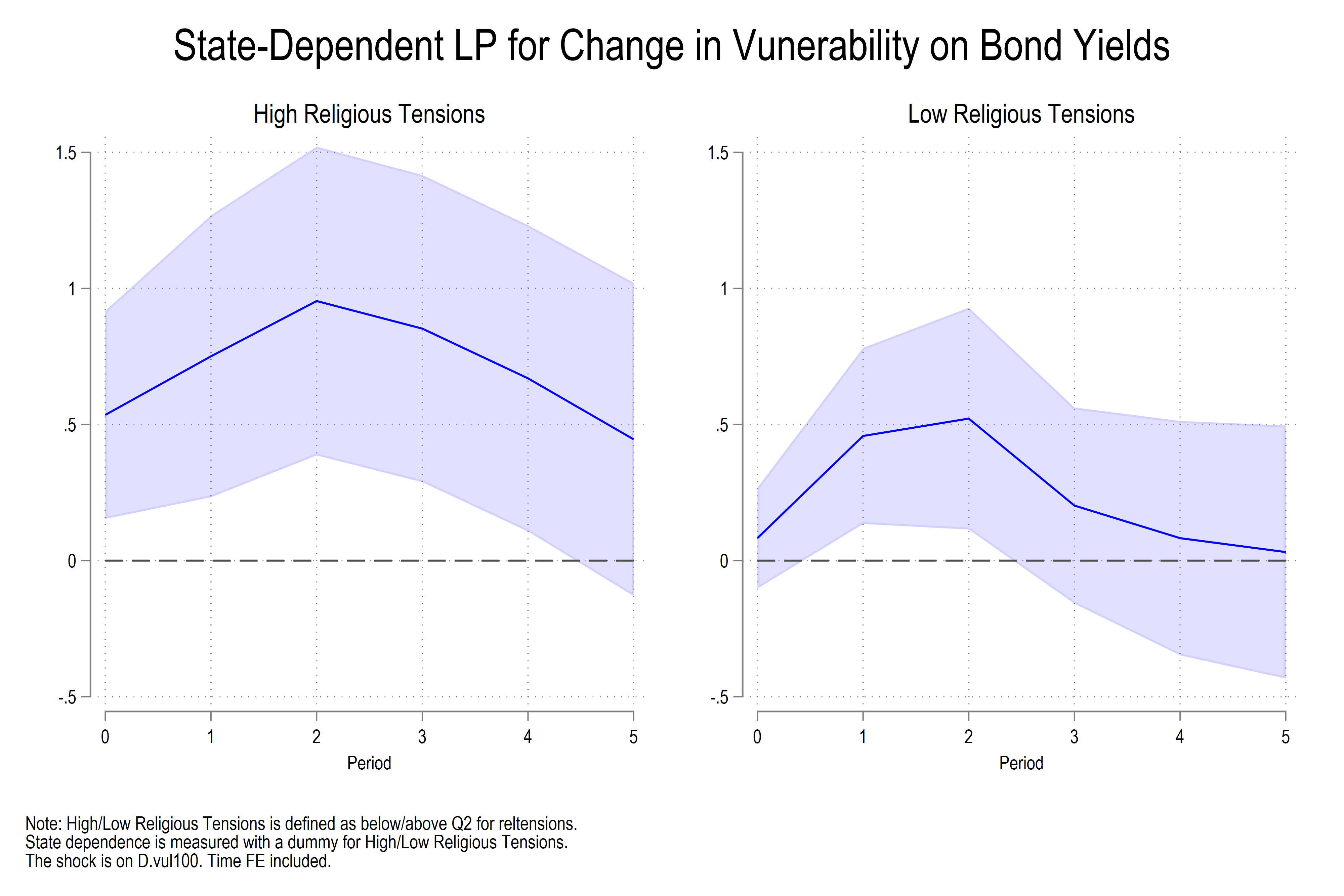
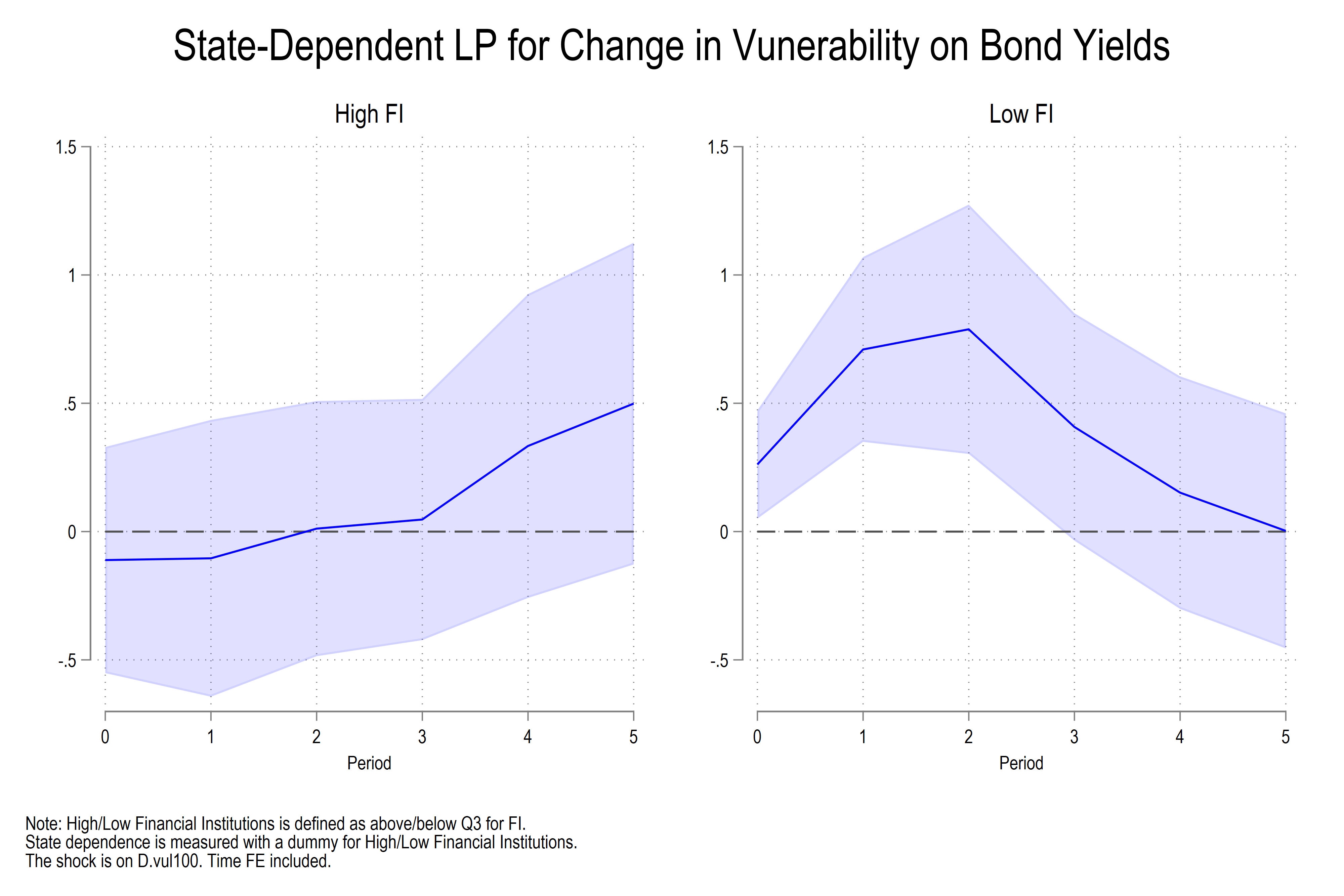
In highly climate-vulnerable economies, increased vulnerability raises government bond yields by 0.5–1.5 percentage points and lowers sovereign debt ratings by up to one notch over two years. Religious tensions amplify these effects, while developed financial institutions provide a buffer.
Published paper (PDF) · Journal article · Replication code and data
The estimated equations
Let \(s_{i,t}=100\Delta V_{i,t}\) denote the change in ND-GAIN climate vulnerability. For bond yields or sovereign ratings, the panel local projections can be written compactly as:
The controls \(\mathbf W_{i,t}\) contain lagged fiscal risk, lagged vulnerability changes, and five future vulnerability changes. Country and year effects are included; expanded specifications add lagged macroeconomic controls. Bond yields are transformed as \(100r/(100+r)\) and winsorized; ratings run from 1 (worst) to 21 (best).
State dependence allows the response to vary with the lagged regime indicator \(D_{i,t-1}\):
The religious-tension comparison uses Wald tests of \(H_0:\beta_h^{(1)}=\beta_h^{(0)}\). The paper reports a difference significant at the 5% level for bond yields.
Religious tensions amplify the borrowing penalty
Religious divisions can hinder a coordinated response to climate pressures. The ICRG religious-tensions score ranges from 0 to 6, with higher scores indicating fewer tensions. The estimates separate observations below and above its median: greater tensions are associated with a larger climate-related bond premium.
Financial institutions provide a buffer
Developed financial institutions support credit, insurance, and risk sharing. Vulnerability shocks raise bond yields in the group with lower financial-institution development. The response is statistically insignificant in the group above the index’s upper quartile. The sovereign-rating results show the same buffering role.
The policy implication is that political stability and financial development complement fiscal consolidation in containing climate-related fiscal risks.
Two related EconMacro posts
My post What Does the Religious Tensions Variable in the ICRG Database Measure? explains the expert-based assessment of religious domination, exclusion, and restrictions on religious freedom. Examples from France and the Netherlands illustrate how the indicator tracks political events and public debates.
My companion post Nickell Bias and Local Projections: An Application to the Fiscal Consequences of Climate Risks applies the split-panel jackknife (SPJ) correction to the climate-vulnerability analysis. It compares conventional and bias-corrected responses of bond yields and sovereign ratings, finding stronger cumulative effects after correction, and provides the Stata code.
Paper and replication
Saadaoui, J., Beirne, J., Park, D., and Uddin, G. S. (2026). Impact of climate vulnerability on fiscal risk: Do religious tensions and financial development matter? Energy Economics, 155, 109180. DOI.