The median currency appreciated almost 10 percent against the dollar during the Federal Reserve’s 2004–07 tightening. In the 2014–18 tightening, it depreciated almost 18 percent. What did countries have on their balance sheets when each cycle began, and how much did that help explain their subsequent performance?
In The Performance of Emerging Markets During the Fed’s Easing and Tightening Cycles, Joshua Aizenman, Donghyun Park, Irfan A. Qureshi, Gazi Salah Uddin and I compare five US monetary cycles from June 2004 to September 2023. Our evidence connects exchange-rate resilience to the size of a country’s reserve buffer at the start of the cycle. The strength of that relationship varies considerably across episodes.
Journal of International Money and Finance · Read the full paper (PDF)
Three tightenings, three different currency outcomes
The first tightening coincided with the expansion preceding the global financial crisis. The second took place as the Fed unwound extraordinary accommodation. The third followed the post-pandemic surge in US inflation. Their durations differed, so Figure 1 compares cumulative movements over each episode. A positive value means that one dollar became more expensive in local currency.
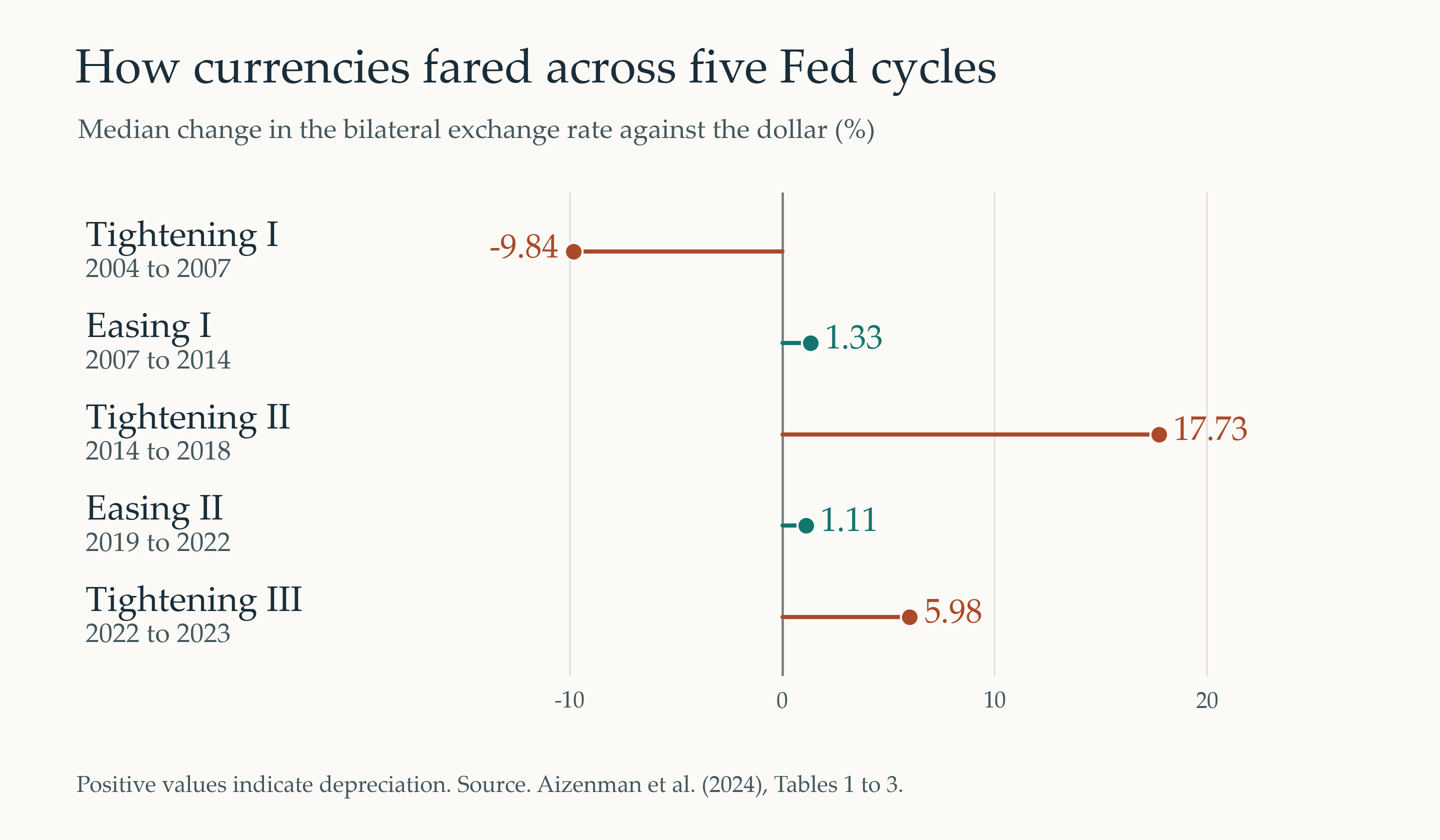
The 2022–23 cycle sits between the two earlier tightenings. The median currency lost about 6 percent against the dollar. An economy could still have weathered this episode relatively well while experiencing depreciation. To assess resilience, the relevant comparison is with other economies facing the same global episode.
What reserves at the outset tell us
For each cycle, we relate the change in the bilateral exchange rate to the country’s economic and institutional characteristics measured in the previous year. Industrialized economies provide a benchmark. The full cross-sectional specifications behind Figure 2 include 54 to 65 countries, depending on the cycle and the availability of the controls.
\[\Delta e_{i,c}=\alpha_c+\beta_c R_{i,c-1}+\boldsymbol{\gamma}_c^{\prime}\mathbf{X}_{i,c-1}+\varepsilon_{i,c}.\]
Here \(\Delta e_{i,c}\) is the percentage change in the domestic-currency price of a dollar over cycle \(c\). The reserve ratio \(R\) measures international reserves excluding gold as a percentage of GDP before the cycle. The coefficient \(\beta_c\) compares economies with different initial reserves, holding the other characteristics in \(\mathbf X\) constant.
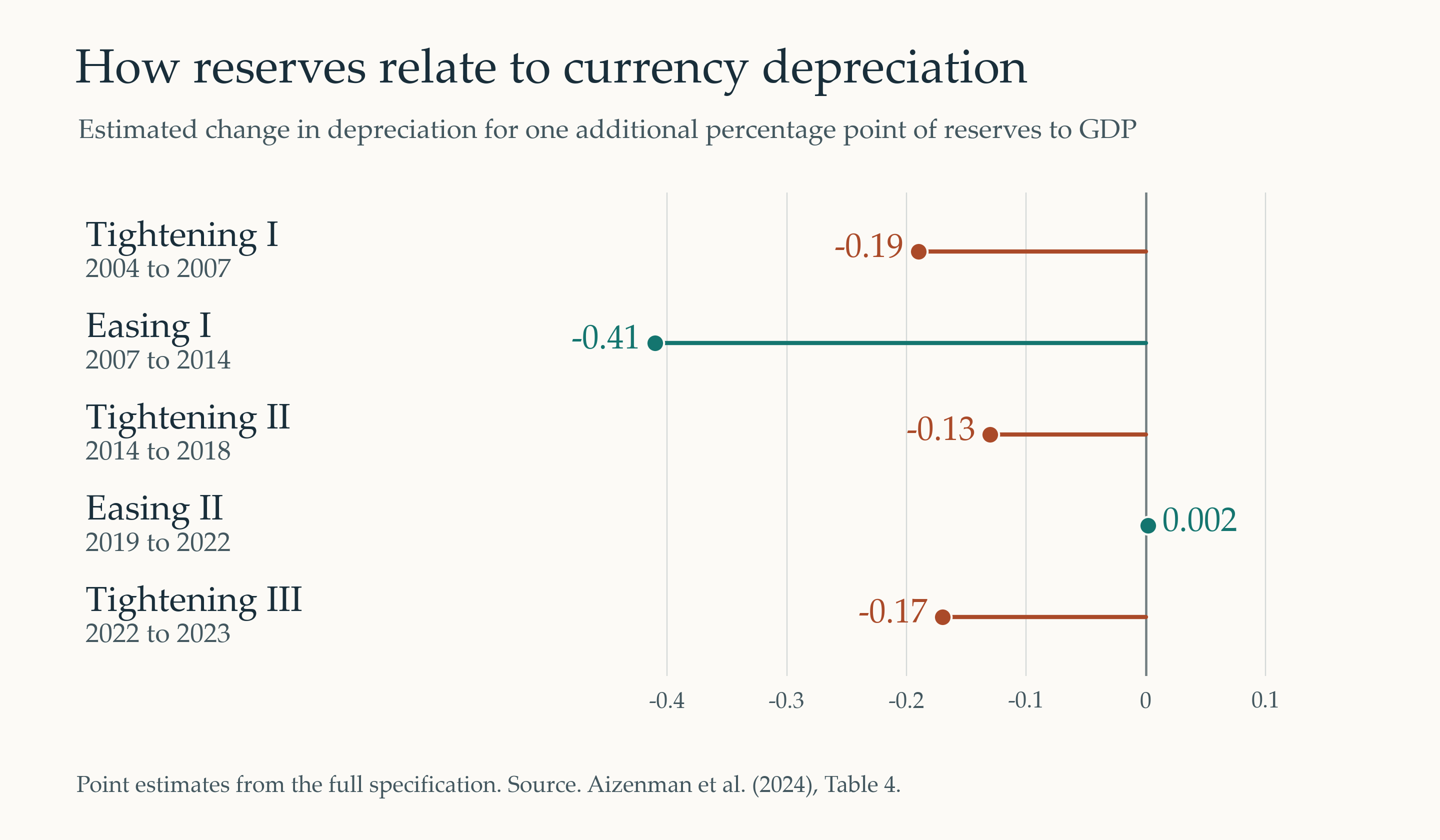
During the 2022–23 tightening, a reserve ratio 10 percentage points of GDP higher was associated with 1.7 percentage points less depreciation, conditional on the other regressors. In the 2019–22 easing, the estimated difference for the same reserve gap was close to zero. The negative estimate for 2007–14 also matters: the financial stress of the global financial crisis coincided with Fed easing.
Why the exchange rate tells only part of the story
A central bank can let its currency adjust or sell reserves to meet demand for foreign exchange. Two countries can therefore report the same depreciation while facing very different pressure. The paper uses an exchange-market-pressure index to capture more of that adjustment. The index covers the first four cycles. The bilateral exchange rate and domestic equity-market index also cover the fifth.
The broader results connect stronger current accounts, reserve holdings and net international investment positions to resilience, particularly during tightening. These measures describe different aspects of an economy’s external position. The current account records a flow of net lending or borrowing. The net international investment position records the stock of external assets less liabilities. Official reserves are the part of the public balance sheet the monetary authorities can draw on directly.
Related literature
Ahmed, Coulibaly and Zlate (2017) ask how far domestic fundamentals explain differences in emerging-market performance during financial stress. Ahmed, Aizenman, Saadaoui and Uddin (2023) focus specifically on reserve holdings during the 2021–22 dollar surge. Comparing five cycles shows when the reserve relationship reappears and how it changes as the global backdrop shifts. Read the 2023 reserve study.
Two related EconMacro posts
- FX Reserves and the Dollar Surge examines reserve holdings and intervention during the 2021–22 dollar appreciation.
- When African Currencies Fall, Do Reserves Cushion the Debt Burden? follows the consequences of depreciation for public debt.
Read the paper
Joshua Aizenman, Donghyun Park, Irfan A. Qureshi, Jamel Saadaoui and Gazi Salah Uddin (2024). “The Performance of Emerging Markets During the Fed’s Easing and Tightening Cycles: A Cross-Country Resilience Analysis.” Journal of International Money and Finance, 148, 103169. Publisher’s version · Full text (PDF).