NEW WORKING PAPER: This paper asks why openness has been such a strong catalyst for catch-up growth in some regions or countries, while in others openness has been followed by stalled convergence, divergence, or stagnation. We conclude that “openness” in today’s geoeconomically fragmented world is much more than trade intensity or trade integration. Positioning in trade networks, trade fundamentals, human capital, institutional capacity and stability matters for the potential for trade-induced productivity gains. We explore the global heterogeneity across continents between 1960 and 2024, unbalanced panel of up to 145 economies per year and estimate a growth equation using a dynamic approach for countries and years. We build a baseline equation relating real GDP growth to lagged income and growth. We complement the traditional drivers of growth by contorting for positionings variables the world economy: a proxy for economic integration measuring the number of regional trade arrangements ratified by each economy, a commodity dependence indicator; metrics related to export networks geoeconomic vulnerability (GeoV). measure country’s export position with geopolitically distant partnerships; geoeconomic connectivity (GeoC) measuring the degree that trade relationships are across greater spectrum of geopolitics. The GeoC measures external “connectors” positioning that may counterbalance costs of geoeconomic fragmentation by securing access to greeter variety of markets and resources. Notably, the Geoeconomic linkages add an important element of “positioning,” indicating that the more “geopolitically” connected is a country, the greater are the investment-growth links. A greater diverse positioning of countries’ economies improves their capacity to transform investment into output in a more diversified setting. This also indicate a lesser dependent growth on “momentum” by countries’ economy, pointing to a greater shock-absorption capacity, confirming the benefits of diversified structure for growth from investments facing pressures from fragmentation.
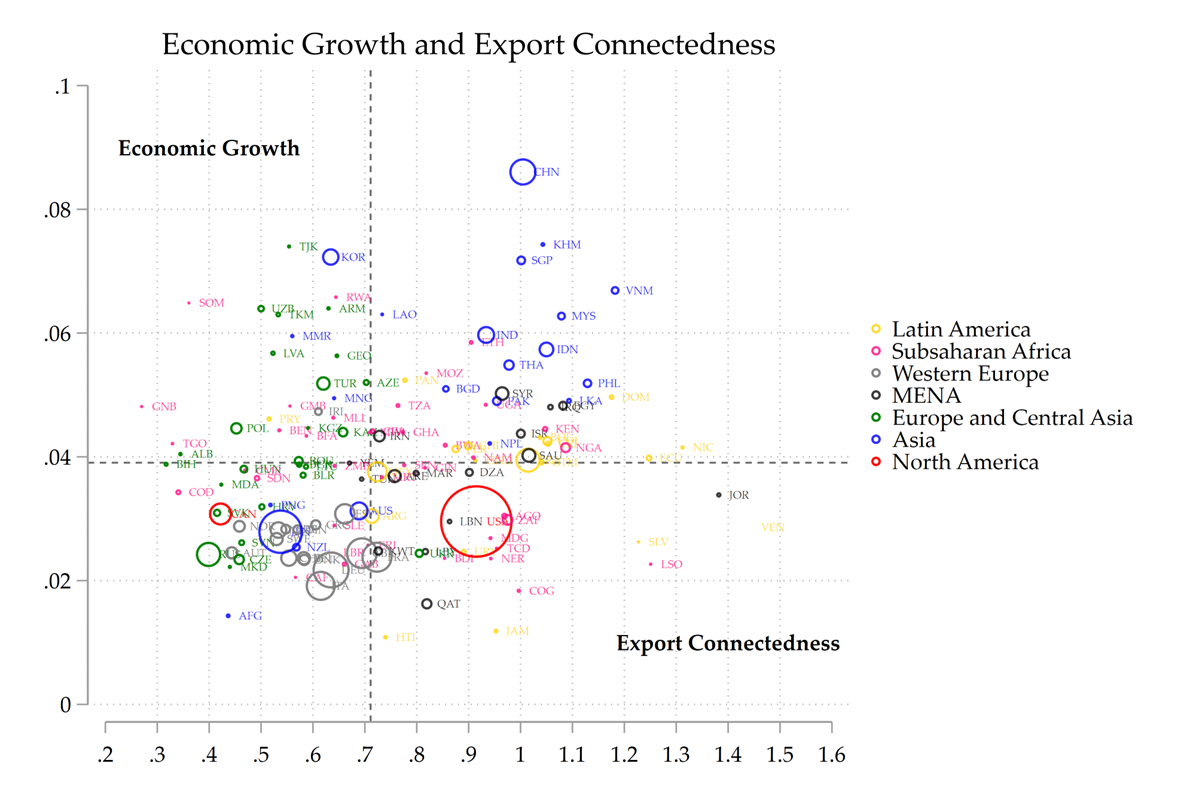
You are welcome to download, share, or comment on the following working paper:
- Joshua Aizenman, Hiro Ito Jamel Saadaoui, (May 25, 2026), Comparative Advantage and Openness under Global Fragmentation: Lessons from the Past 65 Years. NBER Working Paper w35242.