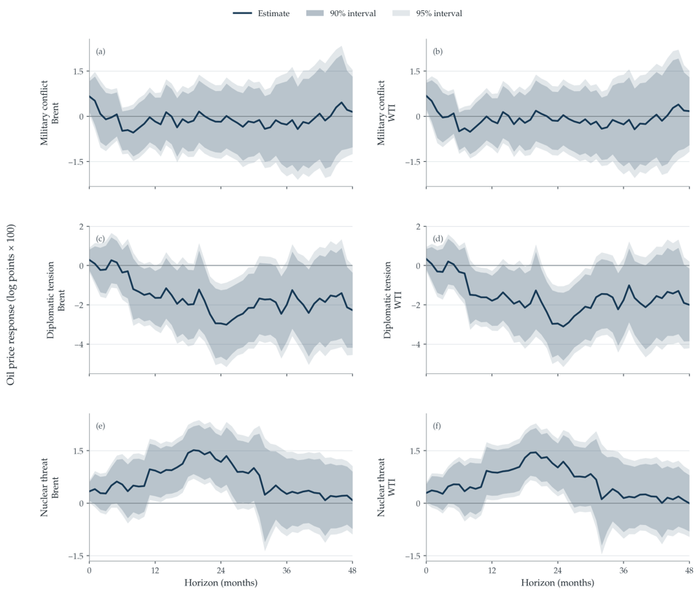
NEW WORKING PAPER: Energy-security decisions often treat geopolitical risk as a common source of upward oilprice pressure. This paper tests that premise using monthly event-specific AI-GPR indices, real Brent and WTI prices, and oil-market fundamentals. The established turning-point identification strategy instruments each geopolitical index with its raw second difference, emphasizing abrupt changes in trajectory. Lag-augmented instrumental-variable local projections reveal different medium-run responses across event types. In the joint Brent model, a 10% increase in one plus the relevant index is associated with an estimated 2.90% price decline after 24 months for diplomatic tension and a 1.18% increase for nuclear threat, conditional on the identifying assumptions. Equality of the principal category responses is rejected at medium horizons, and Sanderson-Windmeijer statistics show that every principal conditional first stage is exceptionally strong. Lead-curvature placebos do not reject for the principal categories, event-window exclusions preserve the main patterns, and the positive nuclear response remains stable in samples ending before 2012 and before 2019. The policy implication is diagnostic rather than mechanical: agencies should combine event-specific geopolitical monitoring with physical-market indicators before interpreting an escalation as an oil-supply emergency.
You are welcome to download, share, or comment on the following working paper:
- Ginn, W., & Saadaoui, J. (20 September 2026). Not All Geopolitical Turning Points Are Alike: Oil Price Effects and Implications for Energy Security Policy. SSRN 7494838.