During the euro-area debt crisis, did stronger public finances precede an improvement in a country’s external position? The answer depends on which country you look at. In France, the fiscal measure helped predict the external one. In Germany, the external measure helped predict the fiscal one. In Spain, we found evidence in both directions.
In our Journal of International Money and Finance paper, António Afonso, José Alves, José Carlos Coelho, and I follow 27 EU economies from the first quarter of 2002 to the last quarter of 2023. The question is how countries adjust over time. If spending rises, does revenue keep pace? If imports rise, do exports keep pace? The 2010–2012 crisis provides a particularly revealing comparison because countries sharing a currency experienced different sequences of adjustment.
Journal article · Full published paper (PDF) · CESifo working paper
What does it mean for a balance to be sustainable?
A budget deficit tells us how far spending exceeded revenue in a given quarter. It leaves open whether revenues tend to catch up as spending changes. A trade deficit raises an analogous question about exports and imports. To measure adjustment, we estimate a separate pair of relationships for each country \(i\) and quarter \(t\).
In the first equation, \(R\) is government revenue and \(G\) is government expenditure. The coefficient \(\beta\) tells us how closely revenue moves with expenditure. In the second, \(X\) is exports and \(M\) is imports. The coefficient \(\gamma\) tells us how closely export earnings move with import spending. A coefficient close to one means the two sides move roughly one for one. We let both coefficients evolve, so a country can strengthen one form of adjustment while the other weakens.
When do public finances lead?
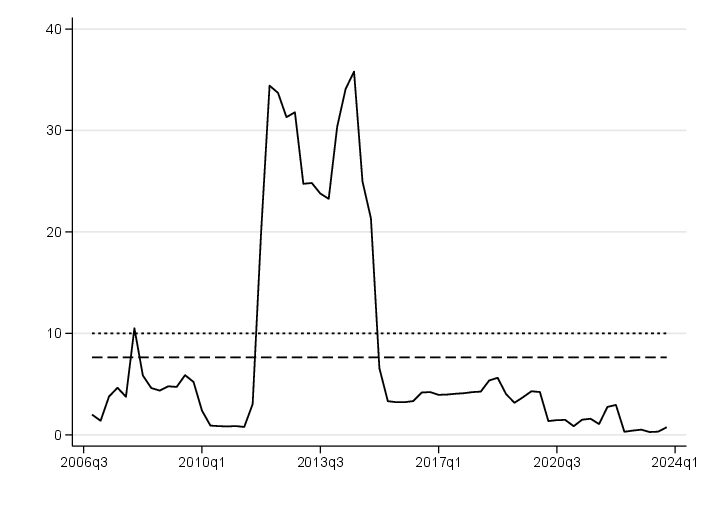
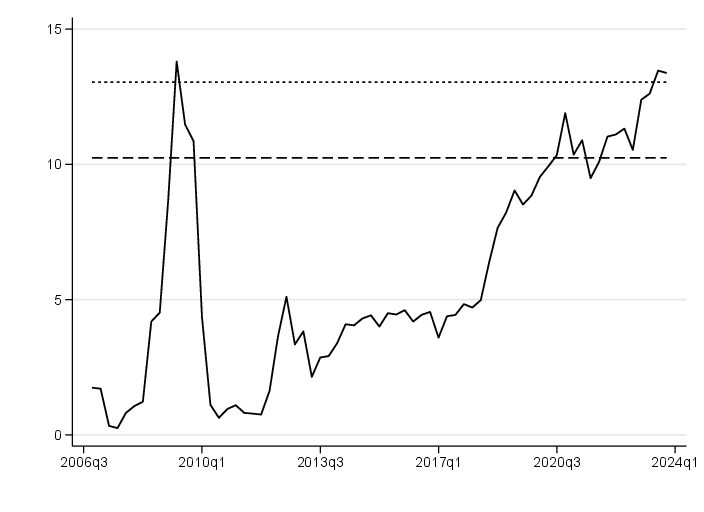
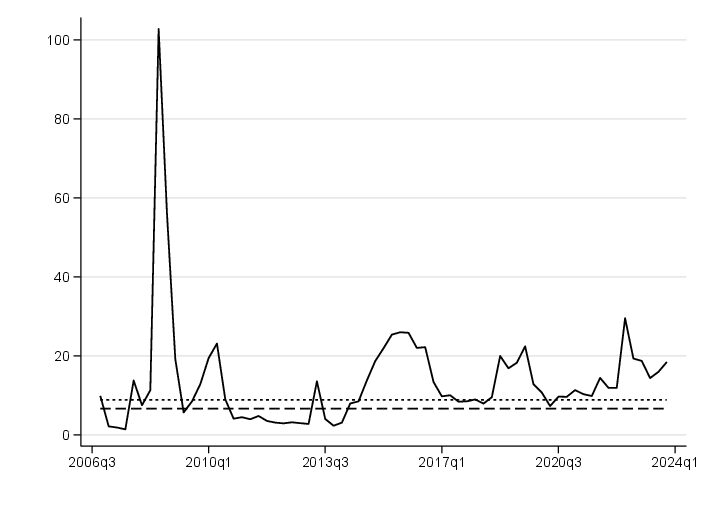
Under the familiar twin-deficits argument, stronger public finances can ease pressure on the external balance. For instance, lower domestic spending can reduce import demand. Figure 1 asks a more precise empirical question. Once we know the history of external adjustment, do past movements in the fiscal coefficient add information about what happens next? During the sovereign debt crisis, the paper reports evidence for France and Spain in this direction.
France
Germany
Spain
When does the external position lead?
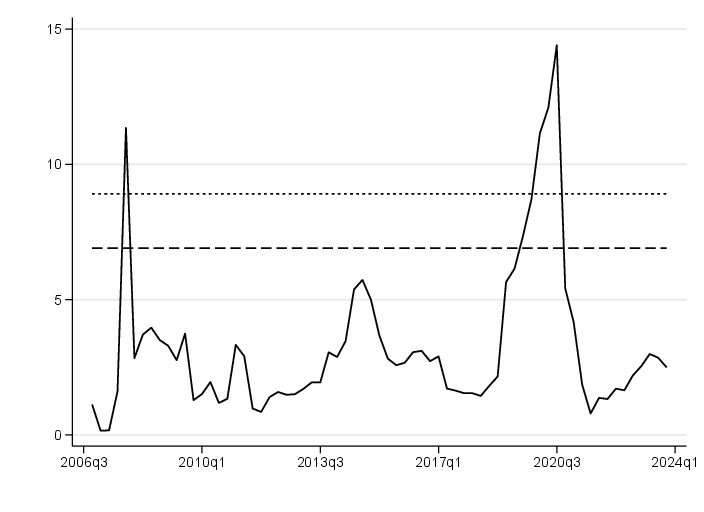
Now reverse the question. A recovery in exports, for example, can raise taxable income and help revenues catch up with expenditures. Figure 2 tests whether earlier external adjustment helps predict fiscal adjustment. During the same crisis, Germany and Spain appear in this group. Spain’s presence in both figures is what makes the comparison informative. A single direction for the whole euro area would miss the feedback found there.
France
Germany
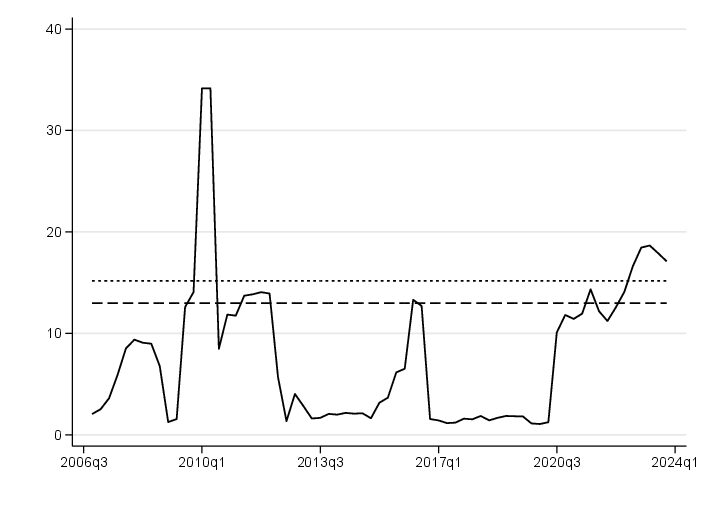
Spain
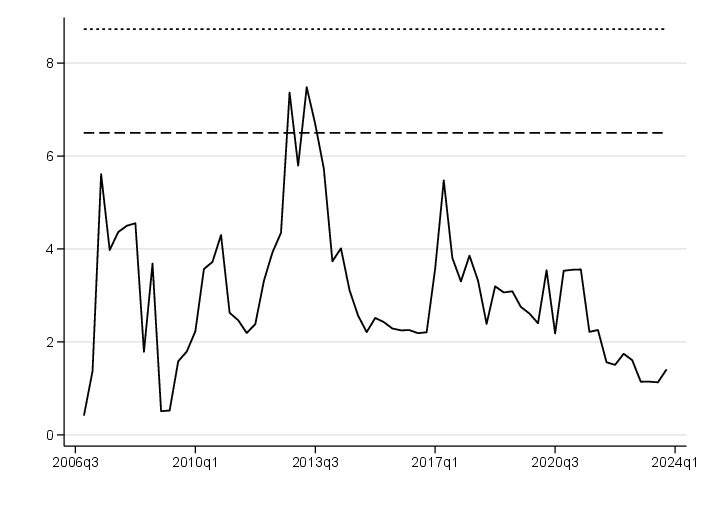
Reading the figures. The statistic is recalculated quarter by quarter, using windows of at least 20 quarters. The two critical values correspond to the 10% and 5% significance levels. A crossing dates an episode of predictability. Its height measures the statistical evidence and does not tell us how many percentage points the budget or trade balance changed.
| Country | Fiscal predicts external | External predicts fiscal |
|---|---|---|
| France | Yes | — |
| Germany | — | Yes |
| Spain | Yes | Yes |
A dash means the paper’s summary of the crisis years does not list the country for that direction. The figures show how the evidence changes outside those years as well.
Related literature
Hakkio and Rush (1991) used the long-run relationship between revenues and spending to test the U.S. government’s budget constraint. Husted (1992) applied a related argument to U.S. exports and imports under the external budget constraint. These papers establish why the two pairs of series carry information about sustainability. We bring them together and ask a further question. At what dates does adjustment on one side provide advance information about adjustment on the other? France, Germany, and Spain give three different answers within the same crisis.
Two related EconMacro posts
- France’s Fiscal Weakness, Italy’s External Constraint compares the levels of the sustainability coefficients and shows how the French and Italian estimates changed after the global financial crisis.
- German Geopolitical Risk and Euro-Area Sovereign Stress looks at another way that euro-area economies can respond differently to common pressures, through sovereign borrowing costs.
Read the paper
António Afonso, José Alves, José Carlos Coelho, and Jamel Saadaoui (2026). “What are the causal links between fiscal and external sustainability in the EU? New time-varying evidence.” Journal of International Money and Finance, 167, 103610. Journal article · Full text · CESifo Working Paper 11694.
Selected references
- Craig S. Hakkio and Mark Rush (1991). “Is the Budget Deficit ‘Too Large?’” Economic Inquiry, 29(3), 429–445. Article.
- Steven Husted (1992). “The Emerging U.S. Current Account Deficit in the 1980s: A Cointegration Analysis.” The Review of Economics and Statistics, 74(1), 159–166. Article record.