A finance ministry sees its deficit shrink and the economy grow in the same year. Did tightening the budget help the recovery? A recovery itself brings in more tax revenue and can reduce the debt-to-GDP ratio. For a government weighing a tax increase or a spending cut, the distinction matters.
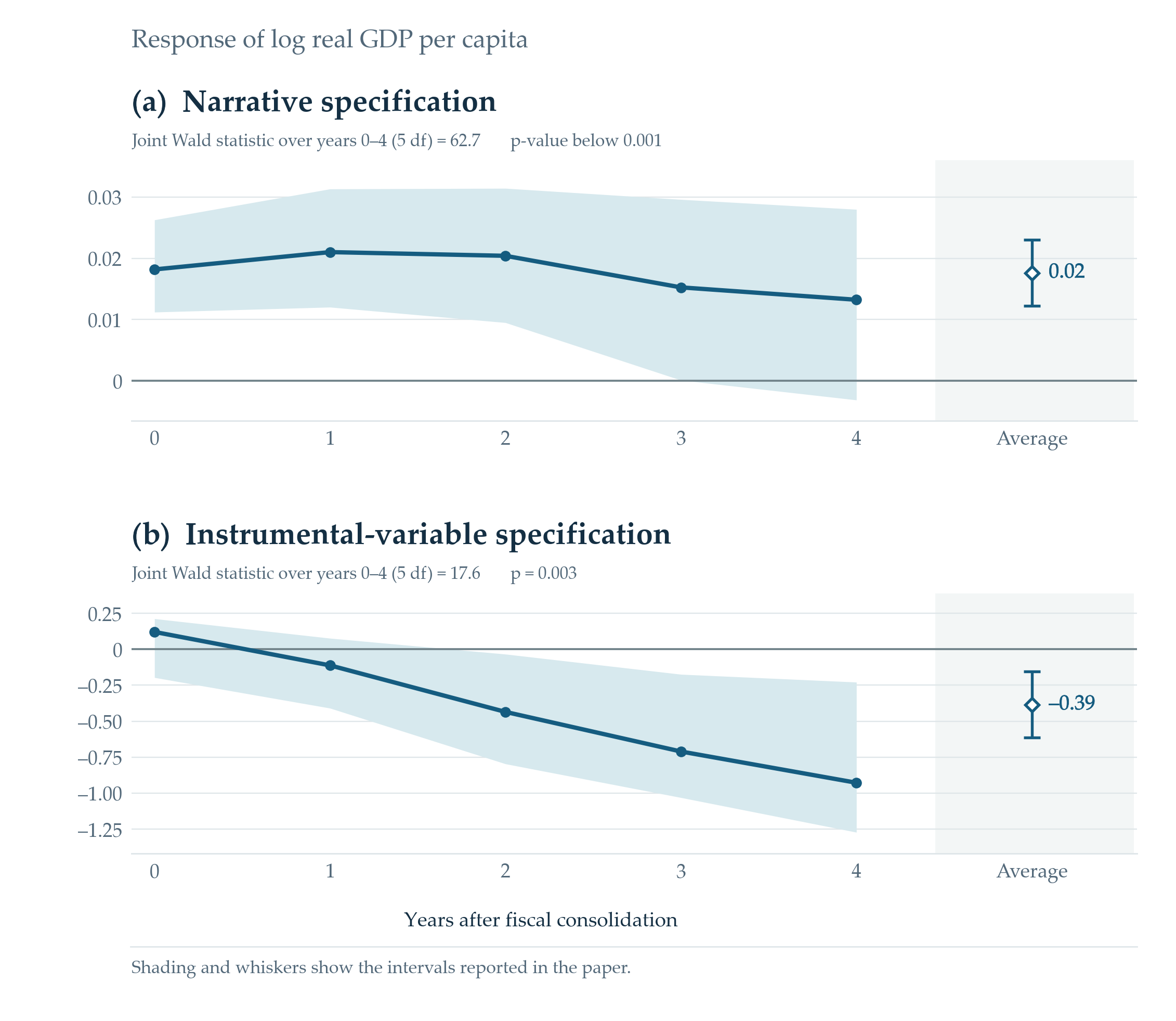
In our 2025 Finance Research Letters paper, Miaomiao Tao, Emilson Silva, and I study fiscal consolidation in 37 Sub-Saharan African economies. When we compare episodes directly, real GDP per person appears to rise slightly after a tightening. When we use those episodes to isolate discretionary changes in the fiscal position, the estimated output response turns negative.
Journal article · Full published paper (PDF) · Working paper
What counts as a fiscal tightening?
We flag a year when the debt-to-GDP ratio falls and the public accounts meet at least one of the three conditions below. For example, a primary deficit that narrows from 3% to 2% of GDP meets the first condition. The primary balance measures revenues less spending before interest payments.
| Fiscal measure | Minimum change, in percentage points of GDP |
|---|---|
| Primary balance | Rises by 1.0 |
| Government revenue | Rises by 0.5 |
| Government expenditure | Falls by 0.5 |
Figure 1 shows two uses of the same information. Panel (a) follows output after years classified as consolidation episodes. Panel (b) uses the episode indicator as an instrument for the change in the cyclically adjusted primary balance. This balance adjusts for the ordinary effects of the business cycle on public finances. The first panel gives the apparent expansion that motivated the paper. The second gives the contraction that matters for the policy question.
Does it matter when the government tightens?
A government that postpones road maintenance reduces the work available to local contractors. In a boom, those firms may have other orders to fill. In a slump, demand from private customers may already be weak. Measuring output separately in the two states lets us ask whether the same fiscal decision has different consequences depending on when it is made.
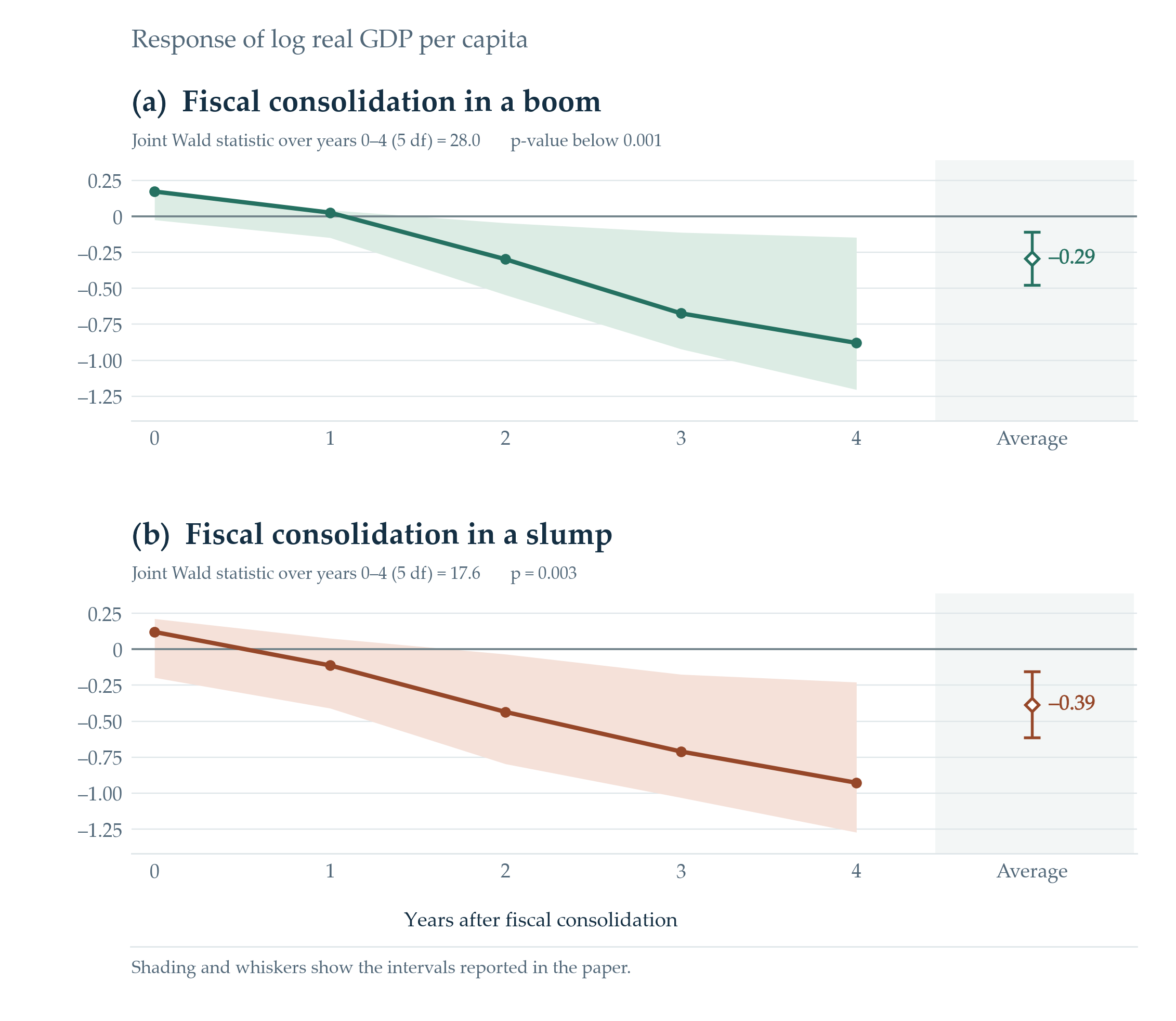
The paper reports a negative average response in both states, with a larger estimated loss in slumps. The slump estimate is imprecise, so the evidence is stronger on the direction of the output cost than on how much extra a downturn adds. The paper also considers global geopolitical risk and economic policy uncertainty. The estimated differences between high- and low-uncertainty regimes are statistically inconclusive.
How the output response is measured
For each horizon \(h\), we compare real GDP per person with its level in the year before the fiscal decision. Let \(y_{it}\) denote log real GDP per capita in country \(i\). A compact version of the instrumental-variable local projection is
Here \(\widehat{\Delta b}_{it}\) is the change in the cyclically adjusted primary balance predicted in the first stage using the episode indicator and controls. Country effects absorb persistent national differences, and year effects absorb common shocks. The baseline uses two lags and country-clustered standard errors. The identifying assumption is that, conditional on the controls, the indicator affects subsequent output through the fiscal adjustment. The coefficient \(\beta_h\) traces the cumulative output response through year \(t+h\).
Related literature
Badru, Calef, Ilori, and Omoju (2025) report an expansion after fiscal consolidation in Sub-Saharan Africa. We recover that pattern in the direct episode comparison. The contribution of our paper is to show how the conclusion changes when the episodes identify variation in the cyclically adjusted balance. Guajardo, Leigh, and Pescatori (2014) likewise show for OECD economies why the way researchers identify a deficit-reduction decision can change the answer they get about output.
Arizala and coauthors (2021) ask a complementary question for Sub-Saharan Africa. They find that cutting public investment imposes a larger output cost than raising revenue. Their result helps explain why the composition of a budget package deserves attention alongside the timing of the adjustment.
Two related EconMacro posts
- When African Currencies Fall, Do Reserves Cushion the Debt Burden? Brief 19 explains how a depreciation can worsen a government’s debt position even before it borrows again.
- When Do Deep Recessions Lead to Strong Recoveries? Brief 13 examines why the depth of a downturn translates into a stronger rebound in some economies than in others.
Read the paper
Miaomiao Tao, Jamel Saadaoui, and Emilson Silva (2025). “How robust is the link between growth and fiscal consolidation under global uncertainties? A reassessment for Sub-Saharan Africa.” Finance Research Letters, 84, 107773. Journal article · Download the full paper.
Selected references and data
- Badru, R., Calef, A., Ilori, A. E., and Omoju, O. E. (2025). “Fiscal consolidation and asymmetric macroeconomic effects: Evidence from Sub-Saharan African countries.” Economic Modelling. Article.
- Guajardo, J., Leigh, D., and Pescatori, A. (2014). “Expansionary Austerity? International Evidence.” Journal of the European Economic Association. Article.
- Arizala, F., Gonzalez-Garcia, J., Tsangarides, C. G., and Yenice, M. (2021). “The impact of fiscal consolidations on growth in sub-Saharan Africa.” Empirical Economics. Article.
- Section 2.2 of the paper describes the fiscal and macroeconomic series from Müller et al. and the World Bank, and the measures of geopolitical risk and economic policy uncertainty. Data definitions.