A welding robot can take over a task on an assembly line. An AI assistant can draft a report that used to take an analyst an afternoon. Both investments automate part of a job. Why might one widen the wage gap between workers with and without a university degree, while the other narrows it?
In our paper in Finance Research Letters, David E. Bloom, Klaus Prettner, Mario Veruete and I show that the answer depends on which tasks a technology can perform. In our model, AI narrows the wage gap when firms can substitute AI for high-skill labor more easily than they can substitute one group’s tasks for the other’s. In a numerical illustration for the United States, the high-skill wage goes from twice the low-skill wage to 1.62 times as much when AI capital reaches the value of the industrial robot stock.
Published article · Open-access PDF · NBER working paper
Which part of the job can a machine do?
The model separates ordinary equipment, industrial robots and AI. Robots can perform tasks that otherwise require low-skill labor. AI can perform tasks that otherwise require high-skill labor. Production combines both sets of tasks. Automating one can therefore change the value of workers who perform the other.
Imagine that drafting the report becomes cheaper. A firm can now produce more analysis with the same number of analysts. What happens to other workers depends on whether more analysis can also take the place of the work they do. When replacing analyst time is easier than replacing those other tasks, the analyst’s wage falls relative to theirs. In the US calibration, AI and high-skill labor have an elasticity of substitution of 2, compared with 1.5 between the two groups of tasks. That difference determines the direction of the wage gap.
From twice the wage to 1.62 times the wage
The skill premium is the ratio \(R\) of the high-skill wage \(w_s\) to the low-skill wage \(w_u\). Let \(A\) denote the high-skill wage advantage in percent. A ratio of 2 means high-skill workers earn 100% more. A ratio of 1.62 means they earn 62% more.
The simulation holds the US industrial robot stock at its 2019 value and varies the value of AI capital. Employment and ordinary capital also stay fixed. The first column shows the value of AI capital relative to that fixed robot stock.
| AI stock | Wage ratio | Wage advantage |
|---|---|---|
| None | 2.00 | 100% |
| Half as much | 1.70 | 70% |
| Same value | 1.62 | 62% |
| Twice as much | 1.52 | 52% |
At equal values of AI and robot capital, the model’s wage advantage falls from 100% to 62%, a decline of 38 percentage points. A high-skill worker still earns more in every row. What changes is how much more.
Reading the two figures together
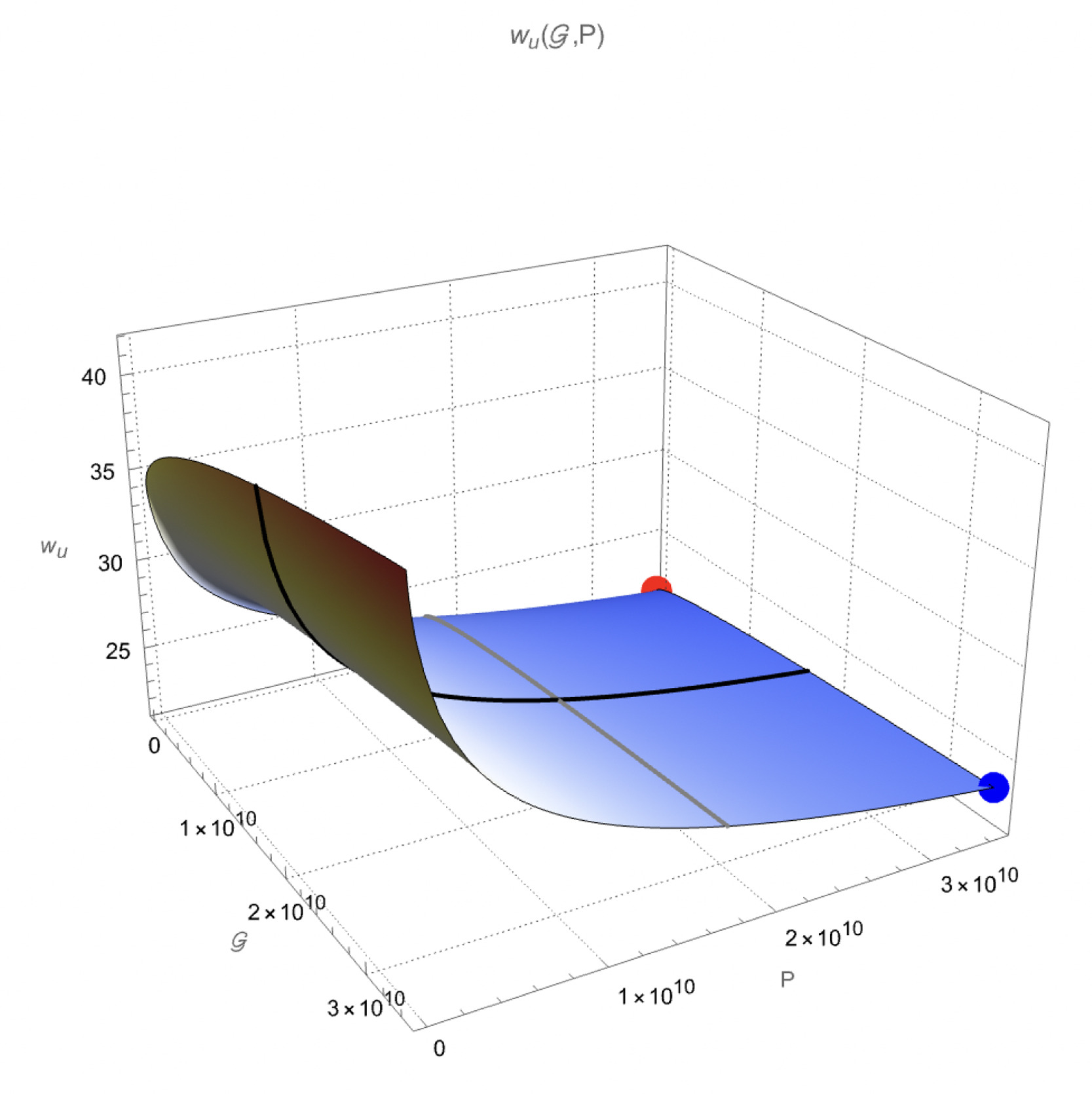
Find the red point in each figure. It represents an economy with many industrial robots and no AI. Then follow the surface toward the blue point, keeping the stock of robots high and increasing AI. In the first chart, the blue point is higher because the low-skill wage rises. In the chart below, the blue point is lower because the wage gap narrows. Reading the first chart alongside the second shows why a smaller wage ratio can matter to the worker on the lower wage.
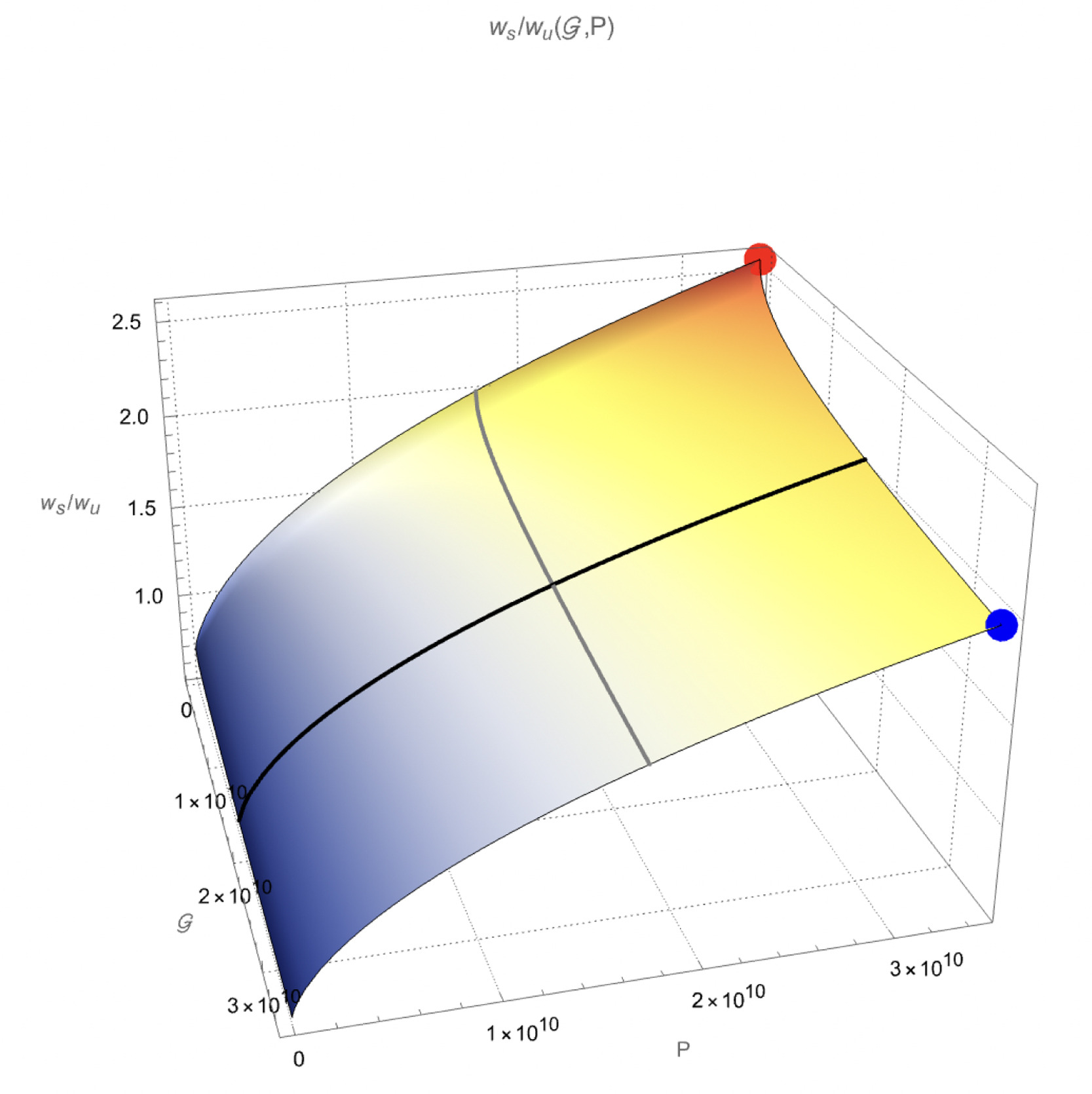
Now hold AI fixed and move along the robot axis. In this calibration, robots widen the wage gap. An economy investing in both technologies therefore faces two forces moving relative wages in opposite directions. The composition of investment matters for who gains from automation.
Related EconMacro posts
Explore the wage equations in Mathematica. The companion notebook derives both wages and lets you vary the quantities of robots and AI in interactive plots.
How Will Artificial Intelligence Affect the Skill Premium?. Our SUERF policy brief examines who receives the capital income generated by AI.
Read the paper
David E. Bloom, Klaus Prettner, Jamel Saadaoui and Mario Veruete (2025). Artificial intelligence and the skill premium. Finance Research Letters, 81, 107401. Download the published article · Mathematica replication files.
Selected references and data
Acemoglu, D. and Restrepo, P. (2018). Low-skill and high-skill automation. Journal of Human Capital, 12(2), 204–232.
Lankisch, C., Prettner, K. and Prskawetz, A. (2019). How can robots affect wage inequality? Economic Modelling, 81, 161–169.
The US calibration uses 2019 physical capital from the Federal Reserve Bank of St. Louis, employment by education from the US Bureau of Labor Statistics, and industrial robot counts from the International Federation of Robotics combined with robot price estimates. Workers with a bachelor’s degree or higher form the high-skill group. Calibration and sources in Section 3.1.